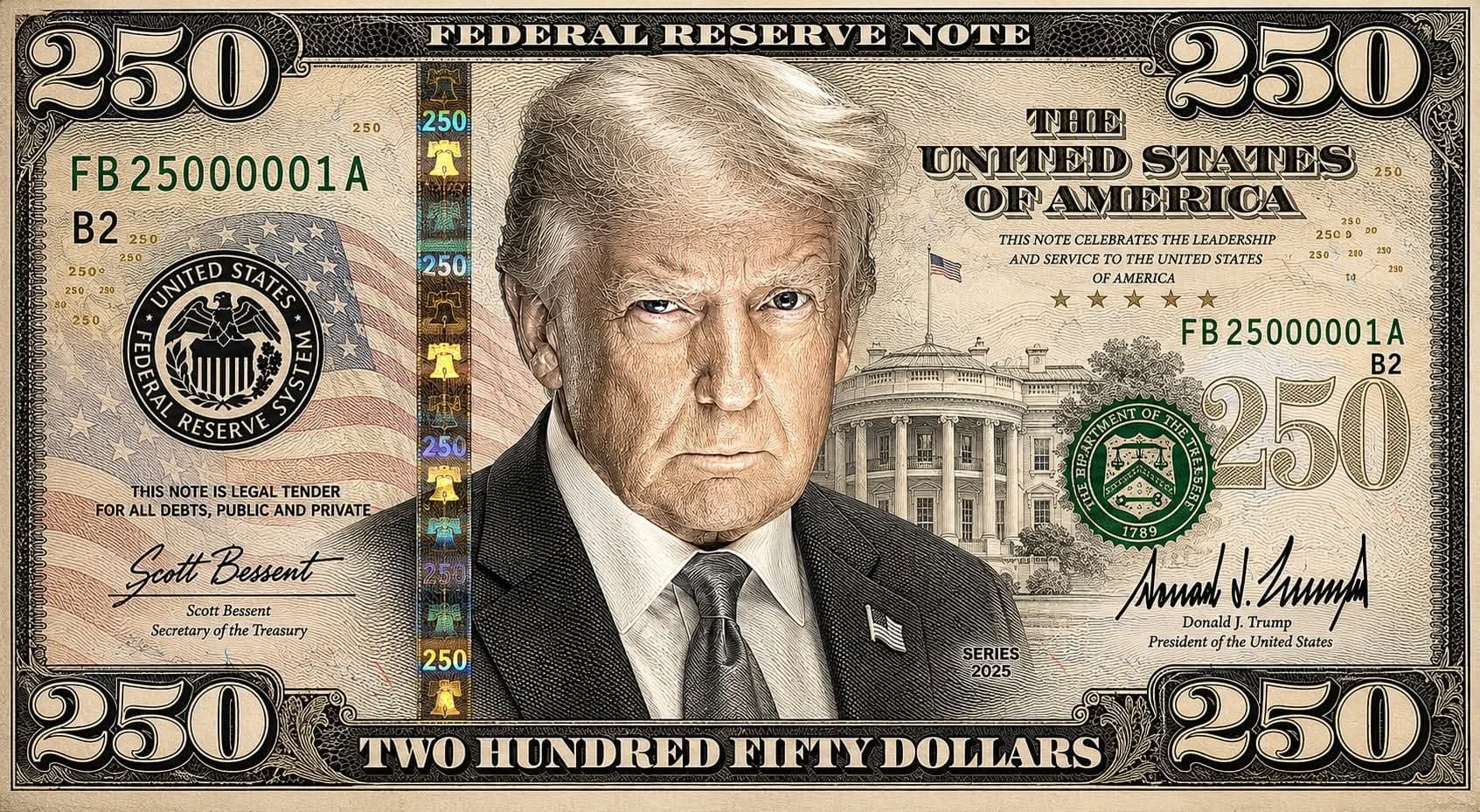
Treasury Department Advances Trump Commemorative Note Plan Despite Legal Obstacles
The U.S. Department of the Treasury has moved forward this week with preliminary design and approval processes for a $250 commemorative banknote bearing the portrait of former President Donald Trump, according to sources familiar with the initiative who spoke on condition of anonymity. The development represents a significant shift in commemorative currency policy, though the project faces an immediate legal barrier that Treasury officials acknowledge has not yet been resolved.
In recent days, Treasury officials have convened working groups to address feasibility questions surrounding the proposed note's introduction into circulation and its relationship to existing currency denomination structures. The timing of this announcement coincides with broader discussions within the incoming administration about expanding commemorative currency offerings and strengthening nationalist symbols within the U.S. financial system.
Legal Constraint: The Presidential Likeness Statute
The primary obstacle to the Treasury's initiative is a provision of federal law that has remained largely unchanged since 1866. Specifically, 31 U.S.C. § 5114 establishes strict parameters governing whose likenesses may appear on circulating U.S. currency. The statute mandates that only deceased presidents whose deaths occurred no fewer than five years prior to the proposed issuance date may appear on circulating currency denominations.
As of this morning, former President Trump remains living, which renders him ineligible under current statutory language. Treasury lawyers have confirmed that the legal barrier is substantial and would require congressional action to overcome. The department has not yet formally submitted a legislative proposal to Congress, though preliminary discussions have begun among key House and Senate committees with jurisdiction over financial services and currency matters.
"The law is clear on this matter," said a Treasury spokesperson in remarks made available to financial media outlets on Tuesday. "Any changes to those parameters would necessarily require statutory amendment through the legislative process."
Commemorative Currency as Political Priority
The push for a Trump-bearing commemorative note has emerged as a priority within certain circles of the incoming administration, reflecting broader efforts to expand the use of commemorative currency as a tool for political messaging and national symbol reinforcement. Commemorative coins and notes have historically served as limited-edition collectibles rather than instruments of general circulation, occupying a different legal category than standard circulating currency.
Treasury officials have indicated that one potential workaround involves designating the $250 note as a limited-edition commemorative item rather than seeking to integrate it into regular currency circulation. This classification might allow production and distribution without triggering the statutory prohibition on depicting living individuals. However, commemorative notes produced under such frameworks typically see restricted distribution and have not historically achieved meaningful use as functional currency in the broader financial system.
Congressional Legislative Options
Several pathways exist for Congress to modify existing law should there be sufficient political will to do so:
Direct Statutory Amendment: Congress could vote to amend 31 U.S.C. § 5114 to remove the five-year-waiting period requirement or to create an exception for living individuals designated by joint resolution or presidential executive authority.
Special Authorization: Congress could pass a discrete authorization permitting a one-time issuance of a Trump commemorative note without affecting the broader statutory framework governing other presidents.
Commemorative Currency Act: Treasury could request that Congress pass legislation under existing commemorative coin and note authority that would specifically authorize a Trump-bearing note outside standard circulation requirements.
In recent days, Republican-controlled committees have begun preliminary discussions about whether such legislative vehicles warrant advancement. No formal bill has been introduced as of Thursday afternoon, though staffers within the House Financial Services Committee have reportedly been tasked with drafting language options.
Historical Precedent and Currency Policy
The restriction on living individuals appearing on U.S. currency has been a consistent principle throughout American financial history. The statutory framework reflects longstanding concerns about currency design being weaponized for personal aggrandizement or the concentration of political power. Presidents ranging from Andrew Jackson to Ronald Reagan have generally accepted the principle that their likenesses would not appear on currency during their lifetimes.
Thomas Jefferson and Alexander Hamilton, whose portraits currently anchor the $2 and $10 notes respectively, did not appear on currency during their administrations. George Washington's ubiquitous presence on the $1 bill was established decades after his death in 1799. This historical pattern has served as a stabilizing principle in American currency design and symbolism.
"Commemorative currency has served important functions as a collector's item and as a tool for marking historical milestones, but the restriction on living individuals has generally protected currency from becoming an instrument of contemporary political messaging," said Dr. Sarah Mitchell, monetary historian at the Brookings Institution, in remarks provided to financial news outlets on Wednesday.
Treasury's Timeline and Next Steps
Treasury officials have indicated that any move toward legislative authorization would need to occur within the next several months to align with broader fiscal year planning and currency production schedules. The department typically requires 18-24 months of lead time before introducing new currency designs into production pipelines.
Sources indicate that Treasury will present preliminary design mockups to Congress-members as early as next month, contingent on whether legislative interest materializes. The proposed denomination of $250 is unusual—the United States has not issued regular currency in that denomination since the discontinuation of high-value notes in 1945, though $500, $1,000, and even $10,000 notes existed historically.
Implications for U.S. Currency Policy
The broader implications of this initiative extend beyond commemorative currency design. If Congress were to alter the statutory framework governing presidential likenesses, it could establish precedent for future administrations to seek similar honors, potentially converting currency design into a more fluid political instrument. Critics have raised concerns that weakening the five-year-waiting-period requirement could undermine the nonpartisan character traditionally maintained in currency symbolism.
Financial institutions and banking regulators are currently monitoring developments without formal comment, though sources within the Federal Reserve have indicated that any new denomination would require substantial coordination with currency distribution networks and automated teller machine manufacturers.
What Happens Next
As of this week, the initiative remains in preliminary planning stages. The statutory barrier remains the controlling constraint on execution. Treasury has confirmed it will continue coordinating with congressional committees, though no formal legislative proposal has been submitted. The ultimate success of the initiative depends on whether Congress votes to modify existing law—a threshold that remains uncertain.
The coming weeks will likely clarify whether this represents serious legislative momentum or exploratory planning that may not advance to formal consideration. Congressional calendar constraints and other fiscal priorities may affect the timeline substantially.