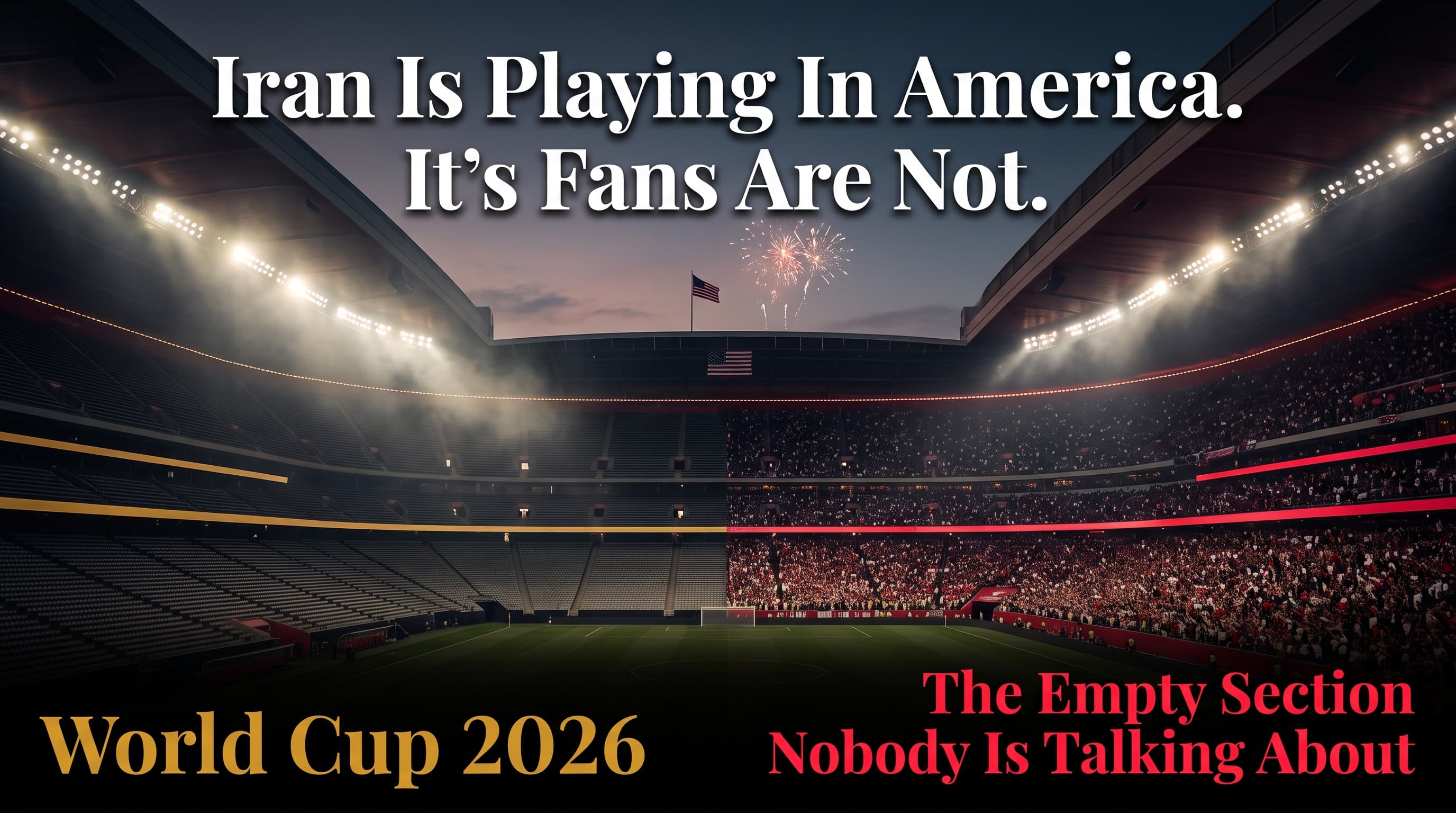
Two World Cup stadiums will pause for national ceremony this weekend. Lincoln Financial Field in Philadelphia and NRG Stadium in Houston are both staging tributes to mark 250 years of American independence, complete with pyrotechnics, a card stunt, and performances built around the Star Spangled Banner. A few hundred miles away, inside the same tournament, the national team of Iran has spent the past month negotiating whether it would be allowed to compete at all, whether its fans could buy tickets, and whether its own staff could get visas to walk into the stadiums where its players are playing.
The tournament this summer is jointly hosted by the United States, Mexico, and Canada, the first time three nations have shared a World Cup and the first edition to expand to 48 teams. FIFA President Gianni Infantino has called it the greatest event humanity has ever seen. But almost every week since the group stage opened on June 11, the tournament has produced a story less about football and more about the politics surrounding it, and no team illustrates that gap better than Iran.
The trouble started months before a ball was kicked. In March, President Trump discouraged Iran from participating at all, telling reporters he did not think it was appropriate given the recent war between the United States, Israel, and Iran, and raising concern for the players own safety if they traveled. Iran national team officials pushed back publicly the next day, saying no one could exclude the country from playing a tournament it had already qualified for. The dispute did not end there. In April, the head of Iran football federation had his visa to enter Canada canceled over his past ties to the Islamic Revolutionary Guard Corps, an organization both Canada and the United States classify as a terrorist group. By June, Iran said visas had been denied outright to fourteen backroom staff and officials, including its federation secretary general, and the Iranian embassy in Turkey accused Washington of the worst possible form of politically biased interference in sport. A US official told reporters the restriction was necessary so Iran could not, in the officials words, sneak people into the country under cover of a sports delegation.
Player visas eventually came through, reportedly processed through the US embassy in Ankara rather than any facility inside Iran, since Washington and Tehran have had no direct diplomatic channel for decades and even less so since the February strikes. But the arrangement came with a condition rarely applied to any other competing nation: because of the still fragile state of relations, Iran players are required to enter and leave the United States on the same day as each of their matches. There is no training camp on American soil, no extended stay, no margin for delay. The team moved its base camp to Mexico instead, flying in and out for each fixture like a squad operating under a curfew that never lifts.
Then came the fans. Iran was allotted roughly eight percent of stadium capacity for each of its three group games in the United States, the standard allocation given to any qualified nation. FIFA revoked it. The stated reason was not political retaliation but the mechanics of American sanctions law. Because the US Treasury Office of Foreign Asset Control blocks financial transactions involving residents of Iran, FIFA said it could not legally process ticket sales to buyers inside the country, even for a global sporting event it was hosting on its own soil. FIFA has said it is trying to let Iranian fans living outside the country buy from the same allocation instead, but for supporters trying to watch their national team compete in a World Cup for the first time on American ground, the message was simple. The team could come. They could not.
Iran was not the only nation caught in the machinery. A Somali referee named Omar Artan, set to become the first person from his country to officiate a World Cup match, was turned away at Miami airport and flown back to Istanbul despite holding a valid visa, after US officials determined he was inadmissible over what the Department of Homeland Security called vetting concerns. An Iraqi forward was held for nearly seven hours at Chicago airport while officers searched his phone. A team photographer was held for over ten hours and ultimately denied entry entirely. Fans from Morocco were denied visas after already buying tickets, and supporters from Scotland had travel authorization revoked with no warning. Of the 48 nations that qualified, fans from Ivory Coast, Haiti, Iran, and Senegal are all covered by travel restrictions that predate the tournament by more than a year.
Inside the stadiums themselves, security has its own political layer. Homeland Security Secretary Markwayne Mullin confirmed in May that ICE agents would be present at World Cup venues, describing their role as primarily security related while declining to rule out arrests. More than 120 immigrant rights organizations issued a joint travel warning ahead of the opening matches, cautioning that fans, players, and journalists could face serious rights violations under the current immigration posture. A stadium workers union in Los Angeles came close to a strike over the same concern before reaching an agreement that let workers walk off the job if they judged ICE activity to be a direct threat.
None of this is happening in isolation from the diplomacy around it. Infantino has built a visible personal relationship with Trump over the past year, presenting him with a newly created FIFA Peace Prize and appearing alongside him at a White House event tied to Saudi Arabia hosting of the 2034 tournament. Analysts at the Chicago Council on Global Affairs have pointed to that closeness as a sign FIFA is increasingly comfortable aligning itself with the political interests of whichever government happens to be hosting, rather than standing apart from them. The same tension runs through the tournament host relationship itself. Trade disputes and rhetoric between the United States and its co hosts, Mexico and Canada, have strained the joint hosting arrangement Trump, Canadian officials, and Mexican officials agreed to years before either country expected the current level of friction between them.
The tournament will run through July 19, when the final is played at MetLife Stadium outside New York, temporarily rebranded for the occasion. Iran was eliminated in the group stage, having played all three of its American fixtures without a single fan in the stands who traveled from home. Whatever else the 2026 World Cup is remembered for, the record attendance, the 48 team format, the ceremonies timed to Americas 250th birthday, it will also be remembered as the tournament where the line between sport and geopolitics all but disappeared.
MorrowReport analysts will continue tracking the intersection of the World Cup, US sanctions enforcement, and the broader Iran relationship through the remainder of the tournament.