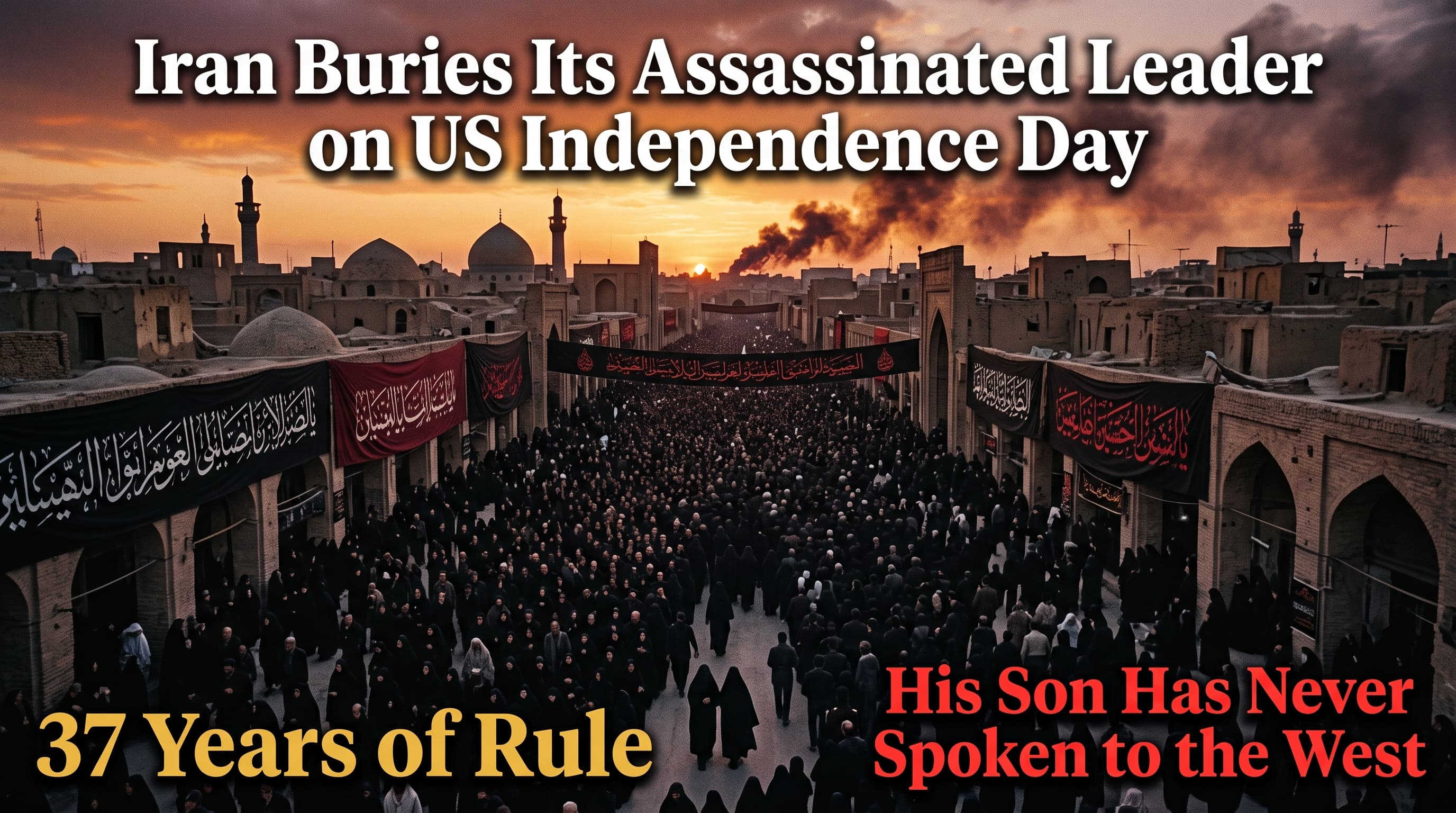
Iran's State Funeral Begins on US Independence Day. The Man Who Replaced Khamenei Has Never Spoken to the West.
geopolitics

Iran's State Funeral Begins on US Independence Day. The Man Who Replaced Khamenei Has Never Spoken to the West.

Four months after Ali Khamenei was assassinated in a US-Israeli airstrike, Iran begins a weeklong state funeral Saturday that overlaps with America's 250th birthday. His successor, son Mojtaba Khamenei, has deep IRGC ties, no public record of Western engagement, and is already a declared assassination target for Israel's defense minister.

By MorrowReport Editorial Team
Friday, July 3, 20266 min read1,264 words

Iran begins placing the body of assassinated Supreme Leader Ali Khamenei on public display Saturday at 6 a.m. local time at Tehran's Imam Khomeini Mosalla mosque, launching a weeklong state funeral spectacle stretching across five cities in two countries that Iranian authorities say will draw millions of mourners. The ceremony begins on July 4 — the 250th anniversary of American Independence Day — a timing that appears deliberate, arriving just as the United States hosts the largest celebrations in its modern history while simultaneously managing the most consequential military aftermath of the 2026 Iran war.

Khamenei was killed on February 28, 2026, at his Tehran residence during a joint US-Israeli airstrike carried out with targeting intelligence from the CIA. He was 86 years old and had led the Islamic Republic for 37 years, longer than any other figure in the country's post-revolutionary history except Ayatollah Ruhollah Khomeini himself. The gap between his assassination and his burial — more than four months — is itself unprecedented in Shia Islam, which holds that burial should take place as quickly as possible and that the fortieth day after death carries particular religious significance. Iranian organizations monitoring the succession have described the delay as a marker of the crisis the regime has been managing since the war began.

The delay was not logistical in the conventional sense. Israel's Defense Minister Israel Katz publicly threatened on March 4 that any leader selected by Iran to succeed Khamenei would become a certain target for assassination, regardless of name or location. Iranian authorities responsible for the funeral face the same security calculus that has defined every major gathering in Iran since February 28: a large, predictable concentration of mourners and dignitaries in a specific location creates an obvious vulnerability in an active war theater. Cooling systems are being installed in the courtyard of the mosque complex. Construction vehicles and cranes are still on site. The logistical operation, which Iranian authorities describe as one of the largest in the republic's history, is being managed simultaneously with military preparedness.

The man who replaced Khamenei sits at the center of every question the funeral raises about what comes next. Mojtaba Khamenei, his second son, was selected by the Assembly of Experts — the 88-member body of senior clerics responsible under the Iranian constitution for choosing the supreme leader — and announced on March 9, 2026, just nine days after his father's death. The speed of the selection was faster than almost any analyst had predicted, in part because Khamenei had reportedly begun preparing for succession while sheltering during the twelve-day war between Iran and Israel the previous June. According to the New York Times, Khamenei had named three senior clerics as his preferred successors in case of his assassination: Chief of Staff Ali Asghar Hejazi, Chief Justice Gholam-Hossein Mohseni-Eje'i, and Hassan Khomeini, grandson of the Islamic Republic's founder. Israel confirmed it killed Hejazi in the February 28 strikes. Trump told ABC News that the attack killed 48 senior Iranian leaders, adding that the preferred successors were all dead by the time succession discussions began.

Mojtaba Khamenei's selection was not free of controversy within the regime. His father had reportedly opposed father-to-son succession, citing concerns that the clerical establishment would view dynastic transfer of theocratic power as uncomfortably similar to the monarchy the revolution overthrew in 1979. The Middle East Institute noted that appointing his own son could cause conflict within Iran's political and religious leadership, and the appointment of a direct successor had never previously occurred in the Islamic Republic. What overcame that institutional resistance was Mojtaba's relationship with the Islamic Revolutionary Guard Corps. His ties to the IRGC and its Basij volunteer paramilitary force are described by analysts as deep and longstanding, making him acceptable to the security-military faction that has increasingly dominated Iranian governance as the clerical establishment has aged and fragmented.

The strategic implications of that IRGC-backed succession are what most concern Western foreign policy analysts. The Council on Foreign Relations said immediately after Khamenei's death that taking out the supreme leader is not the same as regime change, because the IRGC is the regime. A supreme leader who rose to power through IRGC patronage rather than clerical legitimacy represents a structural shift toward security-state governance rather than a transition toward the kind of reformist openness that some Iranian opposition voices hoped Khamenei's removal might enable. Marko Papic, chief strategist at BCA Research, stated that the Iranian economy was soon to become a parking lot unless the next supreme leader was more amenable to negotiating with the United States — a framing that presupposes negotiability as the variable, not a certainty.

Mojtaba Khamenei's public record does not offer optimism on that variable. Unlike Iranian President Masoud Pezeshkian, who signed the Versailles interim agreement with Trump on June 18 and who sits on the constitutional council that managed the leadership transition, Mojtaba has no documented history of direct engagement with Western governments, Western media, or Western diplomatic channels. His public posture has been formed almost entirely within the IRGC's institutional culture. Where Pezeshkian's mandate as president gives him a constitutional role in executing foreign policy and managing the US relationship through the current indirect talks, the supreme leader sits above that process, with the power to approve, constrain, or reverse any agreement the president negotiates.

The indirect talks themselves have continued despite the funeral preparations. Al Jazeera reported on July 2 that US and Tehran representatives wrapped up a round of indirect talks that produced what an Iranian official described as positive progress, with an agreement to establish a communication channel to report and discuss breaches of the June 18 memorandum of understanding. That channel — essentially a hotline for managing escalations rather than a new round of substantive talks — was described as a step forward, though not the formal Switzerland-based signing session that was postponed in late June after Iran's delegation refused to travel following fresh Israeli strikes in Lebanon.

Ghalibaf, the parliamentary speaker who has been leading Iran's negotiating posture since the war's outset, wrote in a message published by state media Thursday that Iran must raise the cry for the nation's blood to the world. His framing, appearing in the same week as the funeral preparations, signals that the regime intends to use the funeral not merely as a religious ceremony but as a political statement: that 37 years of Khamenei's leadership were not defeated by the strikes that killed him, and that the Islamic Republic remains a functioning state capable of staging a ceremony of this scale under wartime conditions. CNN described the funeral as being orchestrated as a victory parade rather than a funeral procession.

For the United States, the optics of the funeral's timing carry their own domestic dimension. July 4, 2026 is the 250th anniversary of American independence, and the country is simultaneously hosting the FIFA World Cup's final stages and organizing the largest patriotic events in generations. That America's largest national celebration coincides with Iran's largest state funeral since 1989 is not by design on either side, but the juxtaposition will define the visual character of July 4 news coverage globally, with a country burying its leader killed by American military action on the same day that country marks its founding. Whether Mojtaba Khamenei uses that coincidence as a symbolic framing for his leadership's opening chapter will be one of the more closely watched signals from the new supreme leader in the days immediately following the burial.

MorrowReport analysts will continue tracking the Khamenei funeral, the Iran-US indirect talks, and Mojtaba Khamenei's first policy signals as the new supreme leader following the burial.

Filed undergeopolitics
Related Stories