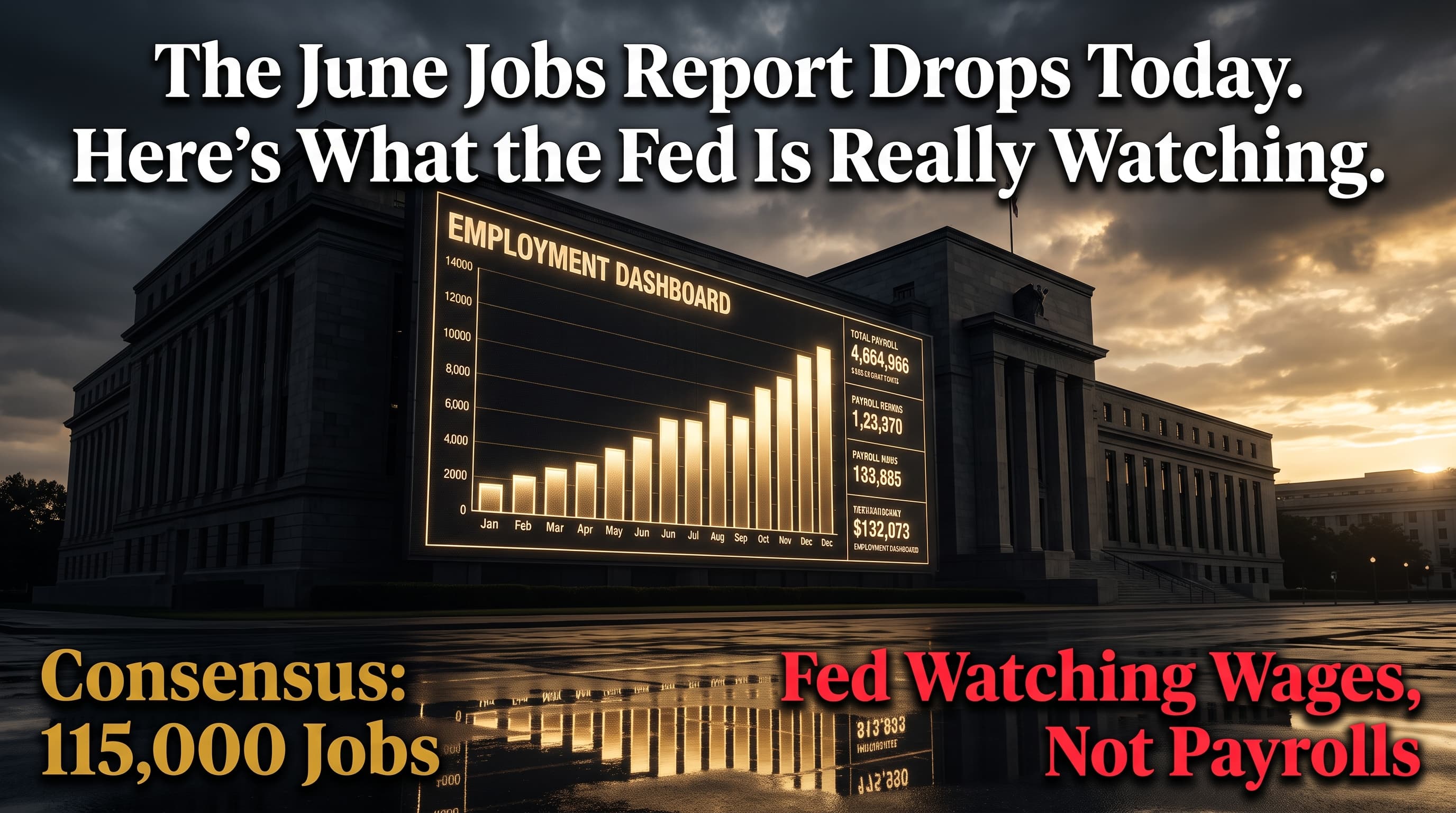
The Bureau of Labor Statistics released its June 2026 Employment Situation report Thursday morning at 8:30 a.m. Eastern Time, one day earlier than its standard Friday schedule because the July 4 Independence Day holiday falls on a Friday this year. The report measures labor market conditions during the pay period including June 12 and arrives at one of the most consequential moments for monetary policy in years — with the Federal Reserve now openly debating a rate hike rather than the cuts markets were pricing at the start of 2026.
Wall Street consensus heading into the release sat at roughly 115,000 new nonfarm payrolls for June, a significant step down from the 172,000 added in May. The range of credible forecasts was wide, with one Bank of America economist projecting 110,000 in private payrolls and the most cautious forecast sitting at 87,000, while more optimistic models pointed to 113,000. That spread, from 87,000 to 115,000, reflects genuine uncertainty about how much the May leisure-and-hospitality surge — which added 70,000 jobs alone and was partly attributed to the FIFA World Cup and Memorial Day timing — would give back in June once that seasonal boost faded.
The unemployment rate was expected to hold at 4.3%, where it has remained since July 2025, though several forecasters noted that continued strength in household employment could push the rate down to 4.2%. Whether that happens depends on the household survey rather than the establishment survey, a distinction that matters because the two measures sometimes move in opposite directions in any given month. The establishment survey, which produces the headline payroll number, counts jobs rather than people; the household survey, which produces the unemployment rate, counts people rather than jobs.
To understand why today's number matters so much, it helps to understand the trajectory that produced it. The labor market in 2025 was effectively stagnant, adding an average of just 15,000 jobs per month over the year, a pace so low that revisions to the benchmark data later showed those estimates were already being overstated. The preliminary benchmark revision released in the spring confirmed that March 2025 nonfarm employment was 911,000 lower than initially reported, a downward revision of 0.6%, representing one of the largest benchmark adjustments in the BLS data series in recent memory and raising serious questions about how accurately the monthly estimates were capturing actual hiring conditions at the time.
Against that 2025 backdrop, the 2026 recovery in payroll growth has been striking. January 2026 added 130,000 jobs, with gains concentrated in healthcare, construction, and social assistance, even as the federal government and financial activities shed positions. March came in at 214,000 after upward revision. April revised to 179,000, and May's 172,000 beat the 80,000 consensus estimate by more than double. The three-month average heading into today's report stood well above what the Fed's own economists consider the labor market's breakeven pace — the number of monthly payroll additions needed simply to absorb new entrants to the workforce, which most at the Fed now place in the range of negative 10,000 to positive 30,000, reflecting demographic slowdown in labor force growth.
That breakeven math is the single most important context for interpreting today's release. In an environment where the economy only needs to add roughly 20,000 jobs per month to keep the unemployment rate stable, adding 115,000 or even 87,000 represents substantial excess demand for labor. Excess demand for labor is inflationary, because it gives workers bargaining power to push for higher wages, and higher wages feed directly into the services inflation component that has been the stickiest part of the Fed's PCE problem. Average hourly earnings grew 3.4% annually as of the May report, and any upside surprise in June wages would add another data point supporting the case for a rate hike at the late-July FOMC meeting.
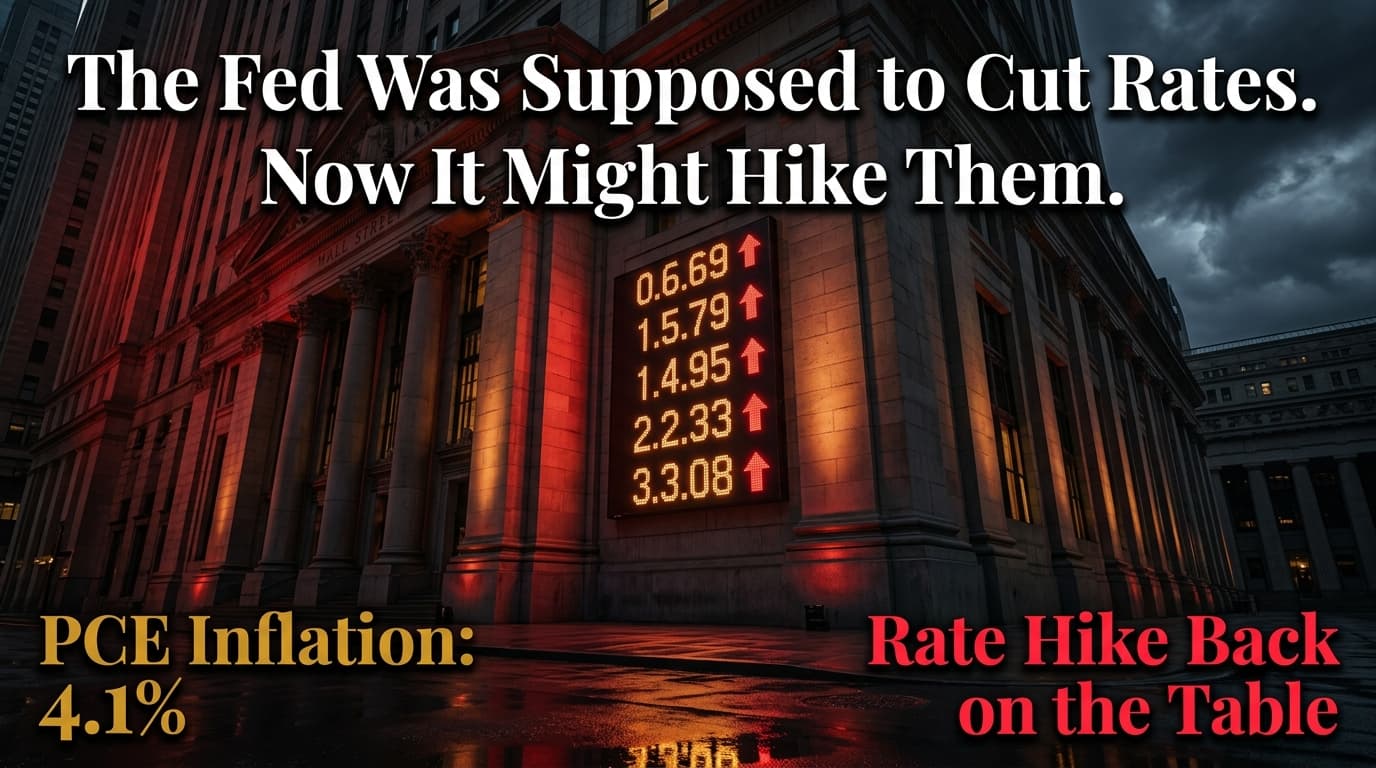
Average hourly earnings in May reached $37.53 per hour for all private-sector employees, up 0.3% from April. The year-over-year rate of 3.4% sits above where the Fed needs wages to be for inflation to sustainably return to its 2% target. The simplified version of the arithmetic is that annual wage growth above roughly 3.0% to 3.5% tends to produce services inflation above 3%, because labor costs are the primary input for most services. With PCE inflation already printing at 4.1% on the headline measure in May and core PCE at 3.4%, a wage print above 3.4% annual growth today would reinforce Minneapolis Fed President Neel Kashkari's view that inflationary pressures go beyond just the Iran war energy shock.
The participation rate at 61.8% tells a story that the headline unemployment rate conceals. Before the pandemic, the labor force participation rate sat near 63.4%, a gap that translates to roughly 4 million Americans who are outside the labor force entirely and not being counted in the 4.3% unemployment figure. The broader U-6 measure, which adds people employed part-time for economic reasons and those marginally attached to the labor market, stood at 8.1% in May — nearly double the headline rate and 8.9% above its pre-pandemic average. The three-month average rate of Americans not in the labor force but actively wanting a job stands at 5.8%, above the 5.4% pre-pandemic norm, suggesting the headline numbers are still running somewhat hotter than the underlying labor market conditions justify.
Financial activities employment has been declining steadily throughout 2026, falling 22,000 in May alone and down 107,000 from its peak in May 2025, reflecting the direct impact of elevated interest rates on banking and insurance sector headcount. Transportation and warehousing has dropped 92,000 since its February 2025 peak. These are the sectors where the Fed's tightening is landing most visibly in employment terms, while healthcare, government, and leisure-and-hospitality have been absorbing displaced workers faster than the rate-sensitive sectors are shedding them. Morgan Stanley's chief economic strategist described this dynamic after the May report: rate cuts still are not on the near-term horizon, but the absence of inflationary threats in wages should quiet some of the chatter about a potential hike — a comment that was made before June's PCE came in at 4.1%.
Bank of America's US economist specifically flagged a downside risk that markets were watching ahead of today's release: May's surge in leisure and hospitality may have been driven partly by the World Cup or Memorial Day timing, and if the timing effect drove any of that 70,000 gain, June would see payback in the sector. Local government added 55,000 in May, also an outsized gain by historical standards, and a partial reversal there would suppress the June headline independent of any underlying weakness.
The bond market's positioning heading into this morning's report has been one of the clearest signals of how seriously traders are taking the rate hike possibility. A strong payroll print — something above the 115,000 consensus — combined with wage growth at or above 3.4% annually would likely push Treasury yields higher and add to bets on a late-year rate increase. A soft print below 90,000 with decelerating wages would give doves at the Fed a data point to argue against tightening, but would not by itself overcome the PCE inflation signal unless accompanied by meaningful downward revisions to prior months.
The July FOMC meeting on July 29 and 30 is now the single most market-sensitive event on the calendar for the rest of the summer. Today's June employment data feeds directly into the Fed's assessment of whether the labor market remains strong enough to justify keeping rates at 3.5% to 3.75%, tightening further, or whether a softening labor market gives them cover to hold without acting. Kevin Warsh, in his first meeting as Fed chair on June 17, dropped the forward guidance framework entirely and said all decisions would be data-dependent. Today's report is exactly the kind of data that framework requires him to respond to.
MorrowReport analysts will update coverage of the June employment numbers and their implications for the Fed's July meeting as the market reaction develops through the trading session.