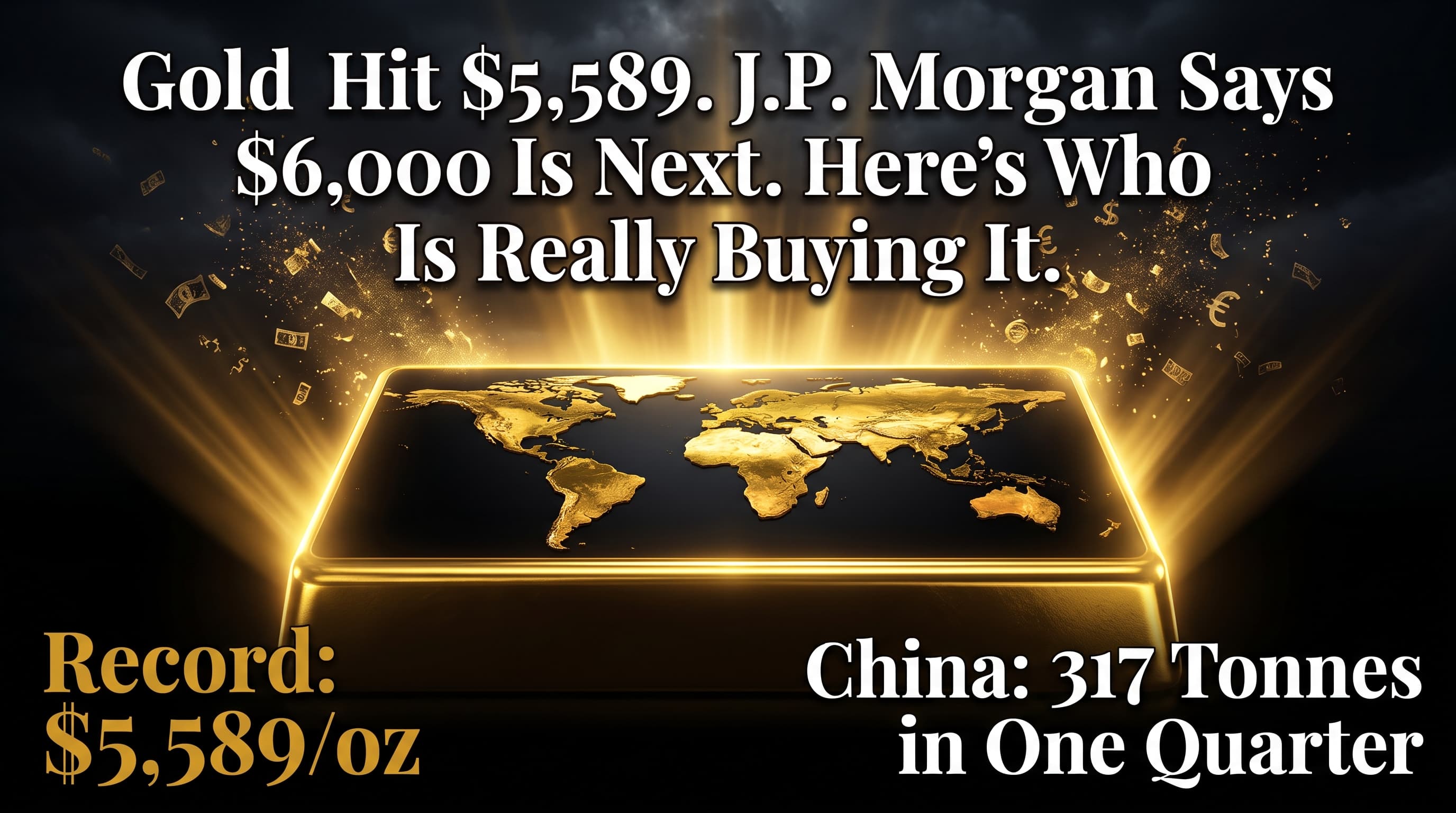
Gold reached $5,589.38 per ounce on January 28, 2026, the highest price ever recorded for the metal in nominal terms, capping a twelve-month run that saw it gain 64% from its starting price of roughly $2,624 at the beginning of 2025. In that single year, gold crossed the $3,000 threshold for the first time, then $4,000, then $5,000, resetting what investors consider a normal gold price three times in rapid succession. No comparable asset of gold's size and liquidity has posted that kind of return in a twelve-month window since the 1970s oil shock era.
The metal has since pulled back from that January peak, trading near $4,047 per troy ounce as of June 30, with J.P. Morgan's analysts describing the current phase as a sideways consolidation rather than a trend reversal. Gold is trading above its 200-day moving average around $4,340 but below its 50-day moving average near $4,730, a technical position that J.P. Morgan's head of base and precious metals describes as a no-man's land — directionless in the short term, with the primary question being whether the factors that drove the January spike return in the second half of 2026 with enough force to push prices toward the bank's year-end target of $6,000 per ounce.
That target, if reached, would represent a further 48% gain from current levels within six months. Understanding whether that is realistic requires separating the short-term noise from the structural forces that have been building in the gold market for years.
The most visible driver of gold's 2025-2026 run is the one that appears in every headline: geopolitical and economic uncertainty. The Iran war, the Ukraine conflict, the tariff disputes, the Supreme Court battles over Federal Reserve independence, and May PCE inflation printing at 4.1% — all of these have pushed investors toward assets that sit outside the traditional financial system. Gold is the oldest such asset, and its price reflects the cumulative anxiety of every one of those events stacking on top of each other since early 2025. The World Gold Council's 2026 outlook specifically highlighted heightened geopolitical and economic uncertainty as the central support for gold's appeal as portfolio insurance, and the events of the first half of 2026 have validated that framing repeatedly.
But the more consequential and less understood driver is central bank buying, and specifically what China is doing behind the scenes in the London over-the-counter gold market. Reported central bank statistics showed a confusing picture in the first quarter of 2026: central banks globally sold a net 129 tonnes, led by Turkey's 60-tonne sale in March, and net reported purchases amounted to only 16 tonnes. On the surface, the central bank buying that powered so much of gold's 2024 and 2025 gains appeared to have stalled.
The World Gold Council's alternative data from the London OTC market and Swiss refinery trade flows tells a completely different story. Using those sources rather than IMF-reported figures, the Council estimates that actual gold purchases in the first quarter of 2026 increased to 244 tonnes from 208 tonnes in the fourth quarter of 2025 — a quarter-on-quarter increase hidden entirely in the gap between what central banks report and what they actually buy. There is no mandatory IMF reporting rule for gold purchases, meaning the gap between official and actual figures can be significant and can persist for quarters before showing up in any public dataset.
China sits at the center of that gap. Chinese net imports of gold came in at 317 tonnes in the first quarter of 2026, nearly three times the prior quarter's figure, while the People's Bank of China simultaneously ramped its reported purchases from roughly one tonne per month for the six months through February to five tonnes in March and eight tonnes in April. The strategic motivation for that acceleration traces directly to February 2022, when the United States and its allies froze roughly $300 billion in Russian central bank assets held in Western financial institutions. That action sent a clear signal to every non-Western central bank that dollar-denominated assets held offshore carry a confiscation risk that gold physically held domestically does not. China, which has been systematically building gold reserves as part of a long-term project to establish the renminbi as a credible reserve currency alternative, has treated that lesson as operational guidance rather than theoretical concern.
The institutional investment side of the market has mirrored the central bank buying cycle with remarkable consistency. December 2025 marked the seventh consecutive month of positive global gold ETF flows, with North American funds leading the inflow, and Morgan Stanley noted in its research that strong ETF demand was absorbing limited inventories after several years of deficits, highlighting a structural supply-demand imbalance that supports prices from underneath regardless of short-term sentiment swings. ETF demand is distinct from central bank buying in an important way: it represents retail and institutional investors making an active allocation decision rather than a sovereign policy decision, meaning it can reverse faster. But the simultaneous presence of both demand sources — central banks buying for strategic reasons and ETF investors buying for return reasons — created the supply pressure that produced the January spike.
Silver ran even harder during the same period, at one point gaining 130% year-over-year, reflecting its dual role as both a precious and industrial metal. The industrial demand side of silver's equation, particularly its use in solar panels and electronics manufacturing, added a second demand driver that gold lacks. Capital Economics, which predicted gold could fall back to $3,500 by year-end, noted that silver tends to follow gold directionally and that any gold correction would likely drag silver more sharply given its higher volatility.
Not every analyst agrees with J.P. Morgan's $6,000 target. Goldman Sachs's forecast of $4,900 by December 2026 is bullish relative to current prices but significantly more conservative than J.P. Morgan's. The divergence between the two banks' targets reflects a genuine disagreement about whether the Iran war's resolution — however incomplete — removes enough safe-haven demand to cap the recovery from January's peak, or whether the structural factors of dollar skepticism, central bank accumulation, and inflation hedging create a new price floor that makes $4,000 the bottom rather than the midpoint of the cycle.
The practical question for individual investors is whether gold at $4,047 is cheap relative to where it is going or expensive relative to where it was. The answer depends almost entirely on whether the PCE inflation trajectory reverses, whether the Iran peace framework stabilizes, and whether China's gold accumulation pace continues at the first-quarter rate. All three of those variables are genuinely uncertain heading into the second half of 2026, which is precisely why J.P. Morgan's Greg Shearer described gold as stuck in technical no-man's land: the fundamental case for much higher prices remains intact, but the near-term catalyst to move it there has not yet arrived.
MorrowReport analysts will continue tracking central bank gold purchase data, gold ETF flows, and the J.P. Morgan and Goldman Sachs price targets as the second half of 2026 develops.