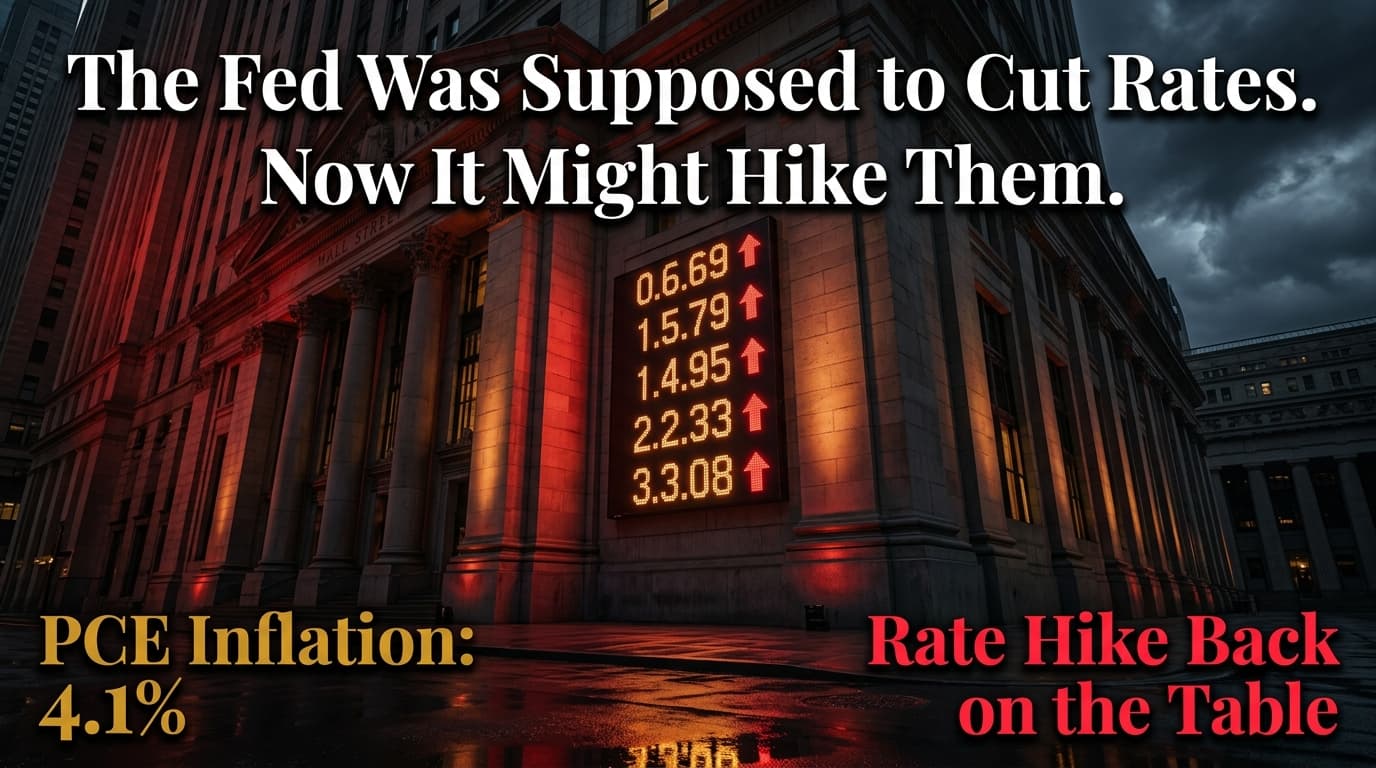
The May Personal Consumption Expenditures price index, the Federal Reserve's preferred inflation gauge, showed headline PCE rising to 4.1% year-over-year, up from 3.8% in April, the highest annual print since early 2023. The data, released Friday, landed hard enough to shift the Wall Street conversation from when the Fed will cut interest rates to how soon it might raise them — a reversal that would have seemed implausible at the start of 2026.
Headline PCE rose 0.4% month-over-month, while core PCE excluding food and energy climbed 3.4% year-over-year and 0.3% month-over-month. The biggest jump in the report came in nominal consumer spending, which rose 0.7% in May to $156.1 billion, with real PCE rising 0.3% after adjusting for inflation. Consumer spending is holding up even as prices rise, which removes the economic slowdown argument that would otherwise give the Fed cover to ease policy.
Minneapolis Federal Reserve President Neel Kashkari, a voting member of the Federal Open Market Committee, said on June 26 that signs of widespread inflation led him to pencil in one interest-rate increase for this year in the Fed's June economic projections. "I'm concerned about inflation, and it's not only tied to what's happening in the Middle East, it's just the impression of broader inflationary pressures in the economy," Kashkari said. His comment separates the Iran war energy shock from the underlying inflation dynamic — the point being that even if Hormuz fully reopened tomorrow, the inflation reading would still be too hot to cut rates.
The Fed's own projections published on June 17 told the same story before Friday's PCE print made it more urgent. The Federal Open Market Committee kept its benchmark rate unchanged at 3.50% to 3.75% for a fourth consecutive meeting, with nine officials projecting at least one rate hike this year and six anticipating at least two. Only nine officials expected no move or a cut, and the Fed revised its PCE inflation forecast sharply higher to 3.6% for 2026, up from 2.7% projected in March, and raised its 2027 forecast to 3.3% from 2.7%. That upward revision across both years signals that the Fed no longer believes inflation is on a clear path back to its 2% target within any near-term horizon.
The CME Group FedWatch Tool, which tracks market-implied rate expectations from futures prices, showed expectations for a renewed tightening cycle surging dramatically over the past week, with traders dramatically increasing bets on rate hikes as the PCE data landed. At the start of 2026, futures markets were pricing two to three rate cuts by year-end. That picture has now inverted entirely, with futures positioning moving toward one or two rate hikes instead.
According to a Bloomberg poll released June 26, economists raised their forecasts for core PCE excluding food and energy to rise 3.2% in the fourth quarter from a year earlier, while estimates for overall inflation were little changed at 3.5%. The poll also boosted estimates for job creation, removing the soft labor market argument that would otherwise support a dovish pivot. A Fed that is watching inflation re-accelerate while the jobs market stays firm has essentially no conventional justification for cutting rates.
The leadership change at the Fed adds another layer of complexity. The June meeting was the first under new Fed Chair Kevin Warsh, whose appointment was initially viewed as leaning toward interest rate cuts and policy easing, but market expectations have since shifted toward a more hawkish stance. Warsh did not submit his own rate projection in the June dot plot, an unusual step that leaves the market without a direct read on where the chair himself stands — though his decision to cut the post-meeting statement to 130 words and drop forward guidance entirely signals a deliberate break from the communication style that markets relied on to price future rate decisions.
The Iran conflict's contribution to the inflation picture is real but not the whole story. Energy prices have pushed headline PCE above core PCE, but core itself at 3.4% is still nearly double the Fed's 2% target. Services inflation, which is driven primarily by wages and shelter costs rather than energy, has remained sticky throughout 2026, suggesting the energy shock is amplifying an underlying inflation problem that existed before the Strait of Hormuz closed. If Hormuz shipping resumes on the EIA's assumed third-quarter timeline, headline PCE may cool, but core PCE is unlikely to follow automatically.
The Fed's GDP growth forecast was revised lower to 2.2% for 2026 from 2.4% projected in March, while the 2027 forecast was kept at 2.3%. That combination — lower growth, higher inflation — is the textbook definition of the stagflation scenario that makes monetary policy genuinely difficult. Cutting rates risks accelerating inflation further. Raising rates risks tipping a slowing economy into contraction. The Fed's next scheduled meeting is in late July, and the June jobs report due on July 3 will be the next major data point determining which direction the debate moves.
MorrowReport analysts will continue tracking the Fed's rate path and monthly PCE releases as the inflation picture develops through the second half of 2026.