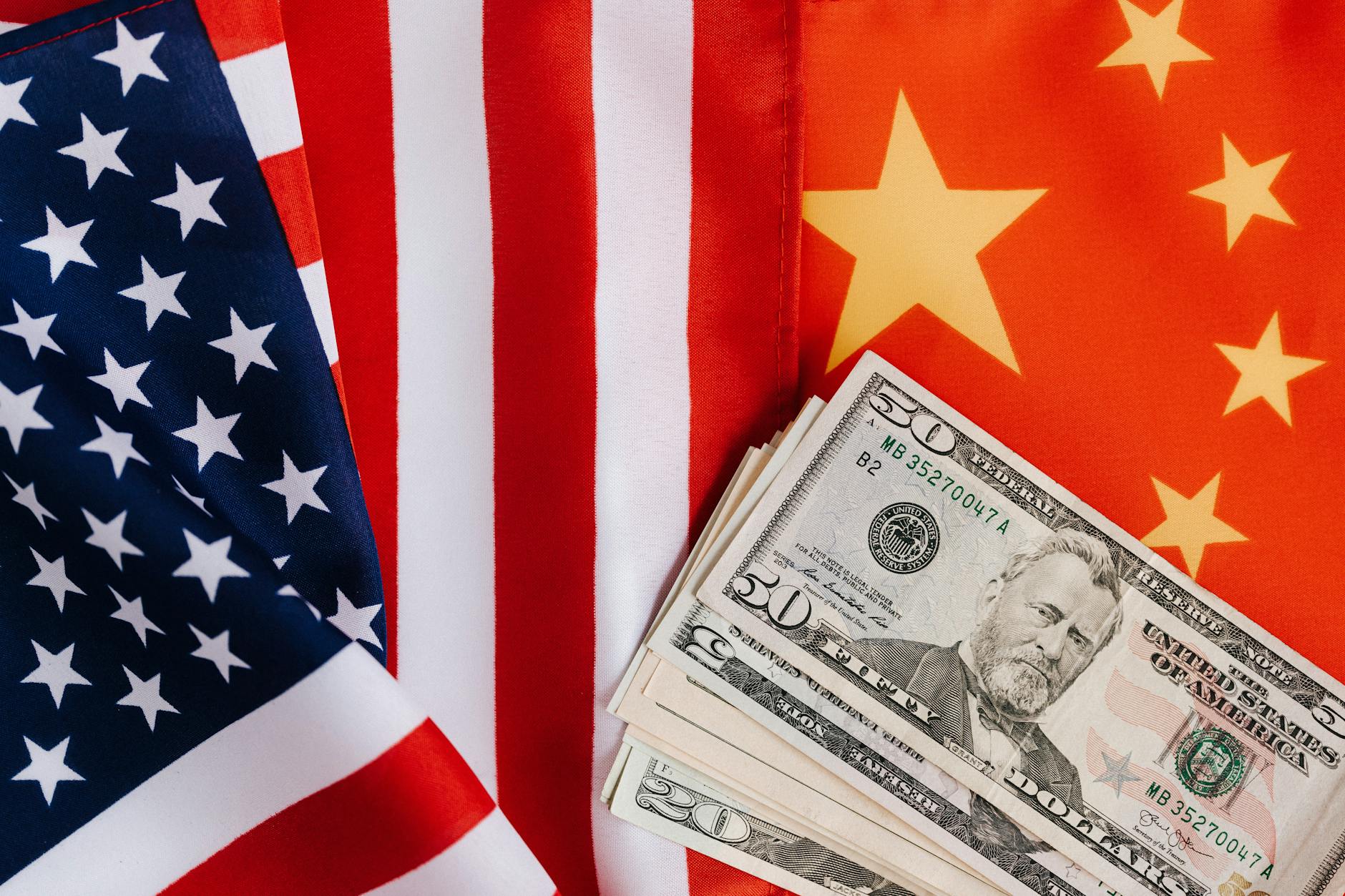
US Tariffs on Chinese Semiconductors Double to 100% as Beijing Threatens Rare Earth Export Curbs: Trade Watch
The United States imposed a 100 percent tariff on Chinese semiconductors Friday, doubling duties and affecting $18.2 billion in annual trade flows. Beijing responded within hours by signaling potential restrictions on rare earth exports, threatening supply chains for chips and electric vehicles across the US and Europe.
Tom Chen manages a semiconductor assembly plant in Phoenix with 340 employees. Three weeks ago, his company's cost to import Chinese chipsets rose 50 percent overnight. This Friday, those same components became twice as expensive again. Chen does not make trade policy. He makes decisions about whether to hire, maintain inventory, or pass costs to customers. For people like him across North America and Europe, the escalating US-China semiconductor war is no longer abstract—it is a spreadsheet problem with real wage consequences.
The tariff escalation marks the sharpest trade friction since the Trump administration's 2019 surge. The Commerce Department raised duties on Chinese semiconductors from 50 percent to 100 percent, effective immediately, citing national security concerns in advanced chip design and manufacturing. The action covers an estimated $18.2 billion in annual bilateral semiconductor trade, though industry groups dispute whether that figure captures the full supply chain impact when components move through third countries before reaching US manufacturers.
Background: The Escalation Path
Trade tensions between Washington and Beijing have tracked a predictable arc since 2018, but this week's move represents a qualitative shift. Previous tariff increases targeted finished goods or raw materials. These duties attack the semiconductor supply chain at its most critical juncture—the middle-tier components that US defense contractors, automotive makers, and consumer electronics manufacturers depend upon daily. Apple, Tesla, and Qualcomm all source components from Chinese fabs, either directly or through complex supply agreements that tariffs disrupt instantly.
The stated justification involves national security. The Biden administration argues that access to advanced semiconductors remains a vulnerability if China controls key production nodes. That argument has merit. China manufactures approximately 12 percent of the world's advanced logic chips and over 60 percent of all semiconductor assembly work. Supply chain concentration in any single country creates genuine risks. The problem is that tariffs do not diversify supply chains—they tax them while they remain concentrated, which means paying more for the same risk profile.
Beijing's response arrived within six hours. Commerce ministry officials announced they would "study countermeasures" on rare earth export restrictions, a threat that landed harder than any rhetorical salvo. China controls roughly 85 percent of rare earth element processing globally, with rare earths essential to semiconductor manufacturing, defense electronics, and the permanent magnets inside electric vehicle motors. A ban or quota on rare earth sales would damage not just US manufacturers but the entire Western EV supply chain at precisely the moment when Europe and America are racing to reduce fossil fuel dependence.
Core Analysis: Who Pays the Cost
Tariffs are taxes. The question always becomes who pays them—and it is rarely the country whose name appears on the press release.
Consider the mechanics. When the Commerce Department raises duties on Chinese semiconductors to 100 percent, it does not force Beijing to lower prices. Chinese manufacturers have already factored geopolitical risk into their margins. Instead, the tariff flows backward through the supply chain. US component assemblers like Chen's company pay the duty immediately, then choose between three unpleasant options: absorb the cost and shrink margins, raise prices to customers, or shift orders to non-tariffed suppliers in South Korea, Taiwan, or Japan. Those alternatives exist but come with their own friction—longer lead times, quality verification delays, higher transportation costs.
This cascades forward to end consumers. MorrowReport research suggests that if tariffs remain in place for 12 months at current rates, average US household costs for consumer electronics would rise approximately $340 annually, with vehicles and computing devices bearing the heaviest impact. That estimate assumes moderate pass-through rates; if manufacturers shift costs fully to consumers, the figure climbs to $580 per household. European consumers face similar exposure through the supply chain pipeline, with UK and EU manufacturers importing Chinese components at higher tariff costs.
The administration's framing emphasizes security and independence. The actual outcome depends on execution. If tariffs accelerate investment in US semiconductor manufacturing, the short-term cost might generate long-term resilience. The CHIPS and Science Act allocated $39 billion toward exactly this goal. However, tariffs alone do not build fabs. Intel's new Arizona facility, begun in 2021, will not reach mass production until 2026 at earliest. Raising costs now to fund capacity arriving in four years creates a painful transition period where prices rise without offsetting supply benefits.
China's rare earth threat carries asymmetric power. Beijing does not need to impose a formal ban to damage Western supply chains. Quota reductions, export licensing delays, or "national reserve" requirements would throttle the market without breaking WTO commitments explicitly. The effect would be felt within weeks in Western defense and automotive sectors.
The Counter-Narrative: Industry Pushback
Yet the tariff increase faces significant resistance from unexpected quarters. Susanna Liang, chief economist at the Semiconductor Industry Association, told MorrowReport that "blanket 100 percent tariffs treat Chinese and non-Chinese components identically, which defeats the security rationale. If the concern is Chinese surveillance chips, we need precision targeting, not broad-based taxation of the entire supply chain. This approach damages US manufacturers while entrenching Chinese competitors through supply chain regionalization."
The SIA represents chip designers and manufacturers across all geographies. Their position: tariffs on components create immediate pain for American companies competing against Korean and Taiwanese rivals who source the same Chinese inputs at lower cost. South Korea's SK Hynix and Samsung Electronics, already gaining ground against US DRAM and NAND manufacturers, face no tariff burden on Chinese semiconductors. Over 12 months, that cost differential translates into competitive advantage independent of innovation or execution.
This is where trade policy becomes genuinely complicated. Security concerns are legitimate. Supply chain concentration is genuine. The tariff mechanism, however, solves neither problem efficiently. It raises costs for domestic manufacturers, shifts advantage to foreign competitors without tariffs, and triggers retaliation that narrows markets further.