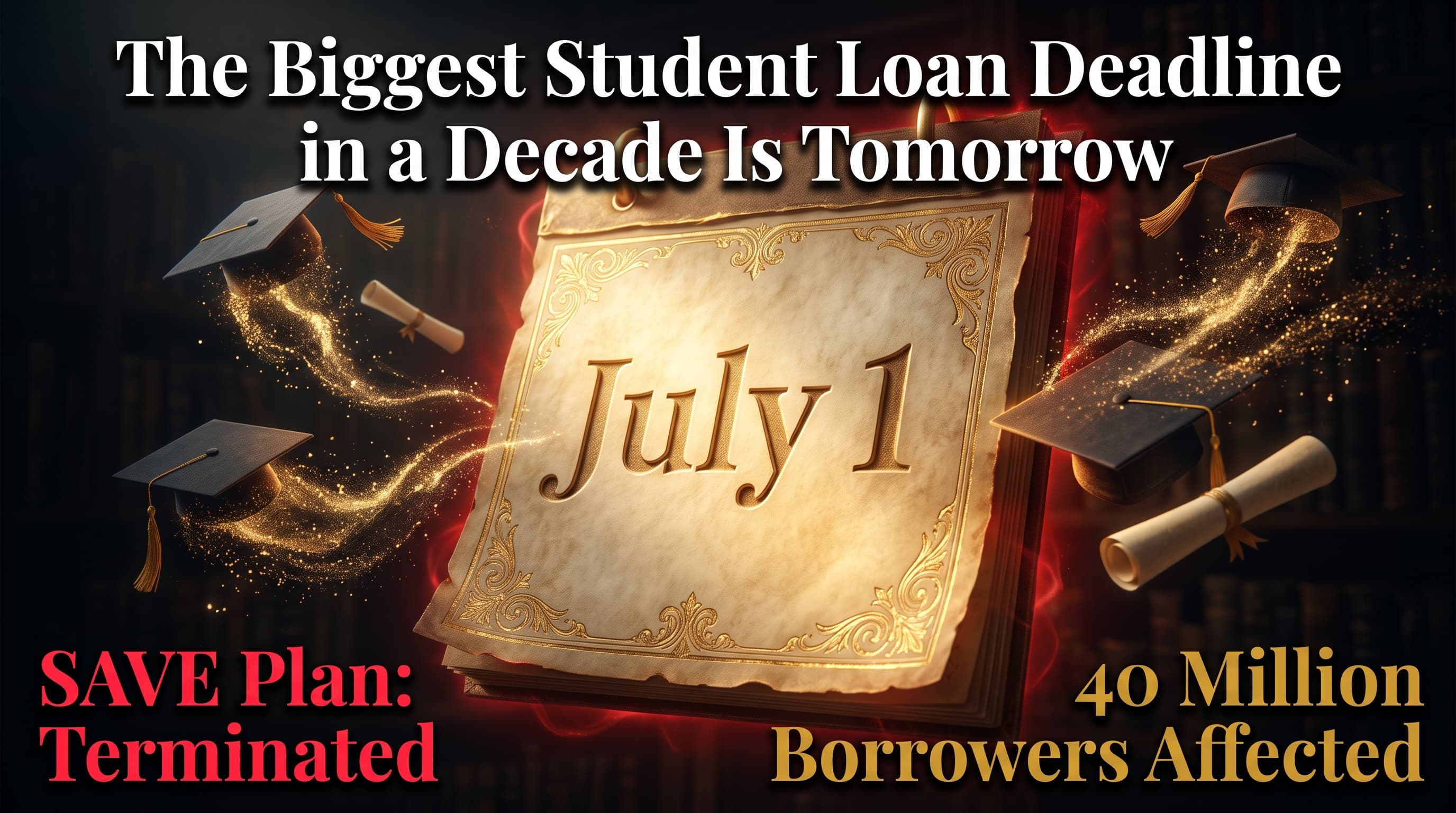
July 1, 2026 marks the most consequential single day for federal student loan borrowers in over a decade, as multiple major provisions of the One Big Beautiful Bill Act's student lending overhaul take effect simultaneously, reshaping repayment options, borrowing limits, and forgiveness pathways for more than 40 million Americans.
More than 7 million borrowers enrolled in the Saving on a Valuable Education plan, expecting eventual loan forgiveness, must now choose a new repayment plan after the program was terminated following a legal challenge. Borrowers enrolled in SAVE have 90 days to select a replacement plan, and if they fail to do so, they will be automatically enrolled in a plan without being able to choose the option that best suits their ability to repay. For borrowers who spent years counting toward forgiveness under SAVE's terms, the termination represents a significant disruption to financial planning that was built around a program the government has now eliminated.
The replacement program carries materially different terms than what SAVE offered. The new Repayment Assistance Plan provides an income-based payoff calculated as 1% to 10% of a borrower's adjusted gross income, with a minimum monthly payment of $10 and no maximum monthly payment limit, with forgiveness allowed only after 30 years of payments. The absence of a payment ceiling is a structural departure from prior income-driven plans, meaning high earners with large loan balances could see payments scale well beyond what they budgeted for under SAVE's more borrower-favorable terms.
Borrowers seeking Public Service Loan Forgiveness who hold Parent Direct PLUS loans must restructure those loans into a Direct Consolidation Loan before July 1 and enroll in an income-driven repayment plan by the same deadline, or income-driven repayment will no longer be an option, leaving only standard repayment plans available going forward. That consolidation requirement is easy to miss, and missing it permanently forecloses a path to forgiveness that many parent borrowers were counting on when they took out the original loan.
Parent PLUS loans face their own separate set of changes tied to the calendar. Parent PLUS loans funded before July 1, 2026 can continue without the new, stricter borrowing limits for up to three more years or until the program ends, while loans initiated after that date are subject to the new caps immediately. Borrowers who are current on payments for a Parent PLUS loan initiated before July 1 may be able to remain on their existing plan until their loan servicer transitions them to a new one by July 1, 2028. The practical effect is a two-year grandfather window that rewards families who locked in financing before the deadline and penalizes those who wait.
Deferment options are also narrowing for future borrowers. Unemployment Deferment and Economic Hardship Deferment programs are being eliminated entirely for loans initiated on or after July 1, 2027, and forbearance will be capped at a maximum of nine months every two years for loans funded on or after that same date. Current borrowers retain access to these safety-net provisions for now, but the elimination date is set, giving borrowers roughly one year to factor reduced flexibility into any future borrowing decisions.
A separate but related change offers borrowers a modest reprieve. The Department of Education introduced a 0.25 percentage point interest rate discount for borrowers enrolled in autopay, with the temporary relief running through June 30, 2028. More than 40 million Americans hold student loans, and borrowers who have already enrolled in autopay will automatically receive the discount, while those who have not must sign up by September 30, 2026 to qualify, and must remain enrolled to keep the benefit. The current average interest rate on federal student loans sits at 6.54%, meaning the discount, while small in percentage terms, can meaningfully reduce total interest paid over the life of a loan.
Private lending markets are responding to the same regulatory uncertainty with rising rates of their own. The average fixed rate on a 10-year private student loan climbed to 8.65% as of the week of June 22, up from 8.02% the week prior, and roughly 0.89 percentage points higher than the same period last year. Financing $20,000 in student loans at the current average fixed rate translates to roughly $250 per month and approximately $9,949 in total interest paid over a 10-year term. Families pushed toward private loans by tightening federal caps are entering a market where borrowing costs have risen meaningfully over the past year.
The broader debt picture provides important context for why these changes matter beyond student loans alone. Federal student loan defaults are climbing again now that pandemic-era protections have fully ended, with the New York Fed reporting roughly 2.6 million additional borrowers transferred to the Department of Education's Default Resolution Group in the first quarter of 2026 alone, following about 1 million defaults in late 2025. The average newly defaulted borrower is nearly 39 years old, and many were current on their loans before the pandemic pause began in 2020, with credit scores for defaulted borrowers dropping 91 points on average. Collections on defaulted loans are currently paused, but that pause may not last, and when collections resume, borrowers face potential wage garnishment, tax refund seizure, and offsets of federal benefits.
With student loan changes arriving alongside elevated mortgage rates, a private loan market with rising costs, and a default wave already underway, July 1 is less a single deadline than the start of a multi-year transition that will reshape how Americans finance education for the rest of the decade. Borrowers who miss the consolidation and repayment plan selection windows in the coming days face consequences that, in several cases, cannot be undone once the deadline passes.
MorrowReport analysts will continue tracking the student loan overhaul and its effects on borrower outcomes as the July 1 changes take effect.