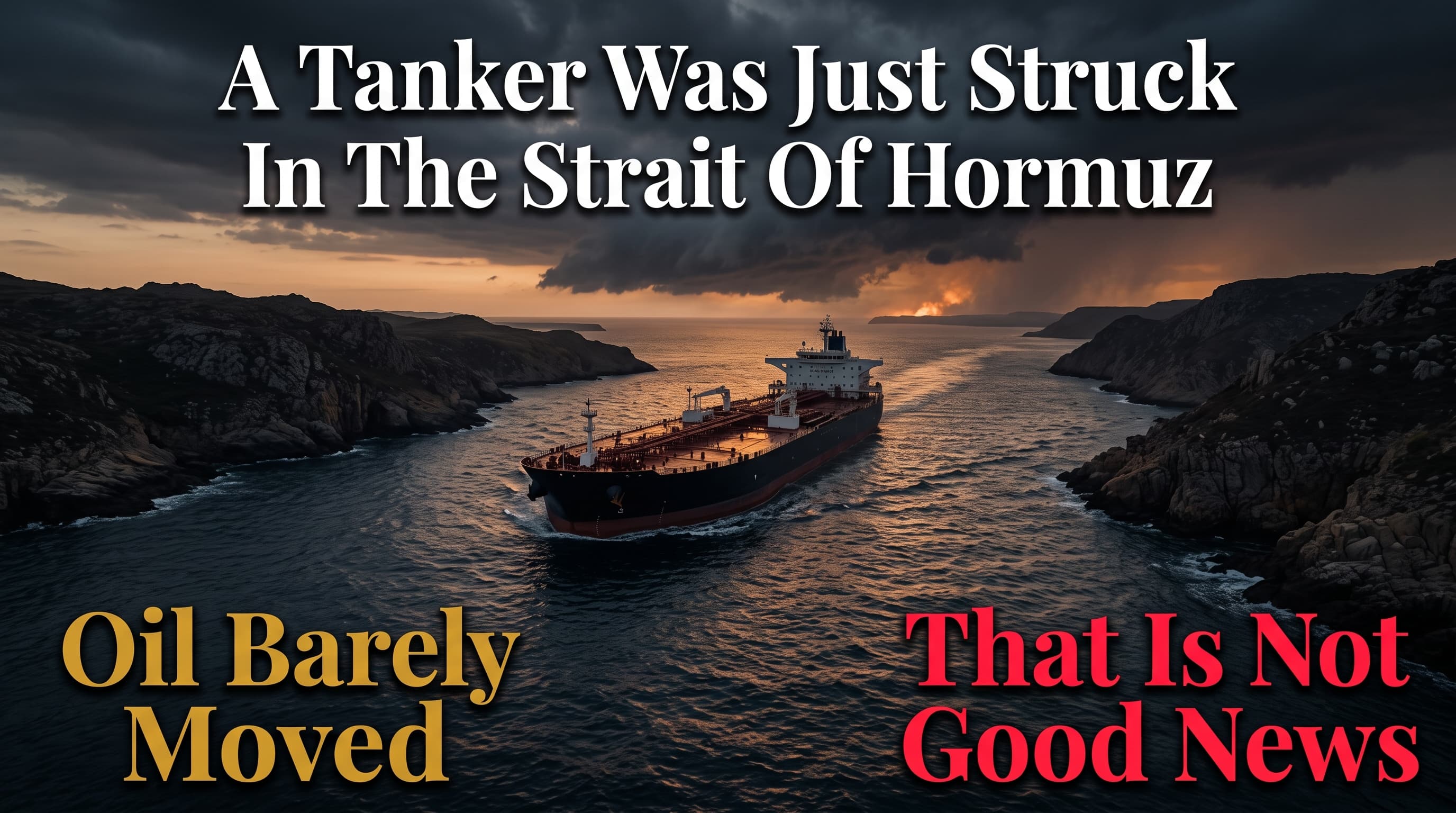
A fully laden liquefied natural gas carrier owned by a Qatari state shipping company was struck by a projectile near the Omani coast on Tuesday while exiting the Strait of Hormuz. The incident is the kind of headline that four months ago would have sent oil prices sharply higher within minutes. This time, crude rose only modestly, climbing above 69 dollars a barrel for West Texas Intermediate and to roughly 72.5 dollars for Brent, and both benchmarks remain close to their lowest levels since late February. The gap between how serious the incident sounds and how little the market actually moved is itself the story.
The strait is the narrow waterway between Iran and Oman through which a large share of the world crude oil and liquefied natural gas physically passes on its way to Asia and Europe. Since the ceasefire built around the Versailles interim agreement, signed June 18 between the United States and Iran, shipping through the strait has been gradually recovering, though tanker traffic still runs below historical averages. Tuesday attack raises an uncomfortable question about how solid that recovery actually is. The Iranian Foreign Minister said publicly that final peace negotiations would stall if geopolitical threats of this kind continue, a statement that reads as much like a warning as an explanation.
Shipowners are responding with their feet rather than waiting for an answer. Reports indicate that at least eight Japan linked vessels have exited the strait using an alternative route that passes closer to the Iranian coastline rather than through the middle of the waterway, including five supertankers each capable of carrying 2 million barrels of crude. That rerouting is a quiet signal that the people whose ships and cargo are actually at risk are not yet convinced the strait is safe in the way official statements suggest it is.
What makes the market reaction so muted is a wave of supply that has been building for weeks and has little to do with the shipping lane itself. OPEC and its allied producers agreed over the weekend to raise production targets by another 188,000 barrels a day starting in August, extending similar increases already made in June and July. The United Arab Emirates pushed its own crude output above 3.8 million barrels a day in June, the highest level since April 2020 and above where production sat before the conflict began. Saudi Arabia added its own signal on top of that. Saudi Aramco cut the official price of its flagship Arab Light crude for Asian buyers by 11 dollars a barrel for August delivery, widening the discount to 1.50 dollars below the regional benchmark. The only other times Aramco has offered that grade at a discount were during the oil price wars of 2020 and 2015, periods defined by producers fighting for market share rather than managing a supply shortage.
The contrast between that supply picture and the US government own modeling is where the real story sits for anyone trying to understand where prices actually go from here. The Energy Information Administration most recent Short Term Energy Outlook, built on the assumption that the Strait of Hormuz would remain effectively closed through the near term, forecast Brent crude averaging 105 dollars a barrel across June and July, only easing toward 79 dollars sometime in 2027 as shipping gradually normalized. Actual Brent prices right now sit more than 30 dollars below that government forecast, which tells you the physical reopening of the strait, however fragile it looked on Tuesday, has already progressed further and faster than official modeling assumed just weeks ago.
That gap matters well beyond a single Tuesday headline. The same EIA outlook estimated that Middle East oil production had been running more than 11 million barrels a day below pre conflict levels in May, and it forecast that global oil demand would actually shrink by 1.1 million barrels a day over the course of 2026, a sharp reversal from the growth the agency was projecting back in February before the war began. Those are the ingredients of a market that has been more damaged on the demand side, by high prices curbing consumption, than most people appreciate, even as the supply side recovers faster than expected.
None of this means the risk from Tuesday incident is imaginary. The EIA own baseline assumes it will take until early 2027 for traffic through the strait to fully return to pre conflict levels, and diesel and jet fuel wholesale prices are still expected to rise more than 60 percent and 40 percent respectively in 2026 compared to the forecast the agency published in February, before the war began. Gasoline wholesale prices are expected to climb by roughly 50 percent this year on that same comparison. Those are the numbers that eventually show up at the pump and in shipping costs on ordinary goods, regardless of what the futures market did in the hour after a single tanker was struck.
What Tuesday really demonstrated is that the market has started pricing risk and supply as two separate questions rather than one combined story, and for the moment supply is winning the argument. A ceasefire that both sides still describe in fragile terms, an active attack on a laden tanker in the very waterway that ceasefire is meant to protect, and an Iranian foreign minister openly floating the collapse of peace talks would have been more than enough to send oil sharply higher at any point during the war itself. Instead, a genuine supply glut from OPEC, the UAE, and Saudi Arabia largest producer has grown deep enough to absorb that shock almost without a ripple. That absorption capacity is reassuring for anyone paying at the pump today. It says nothing at all about what happens if a similar incident occurs after that supply cushion has thinned, or if Tehran comment about stalled negotiations turns out to be more than a rhetorical warning.
MorrowReport analysts will continue tracking Strait of Hormuz shipping activity, OPEC production decisions, and the durability of the Versailles interim agreement through the remainder of the summer.