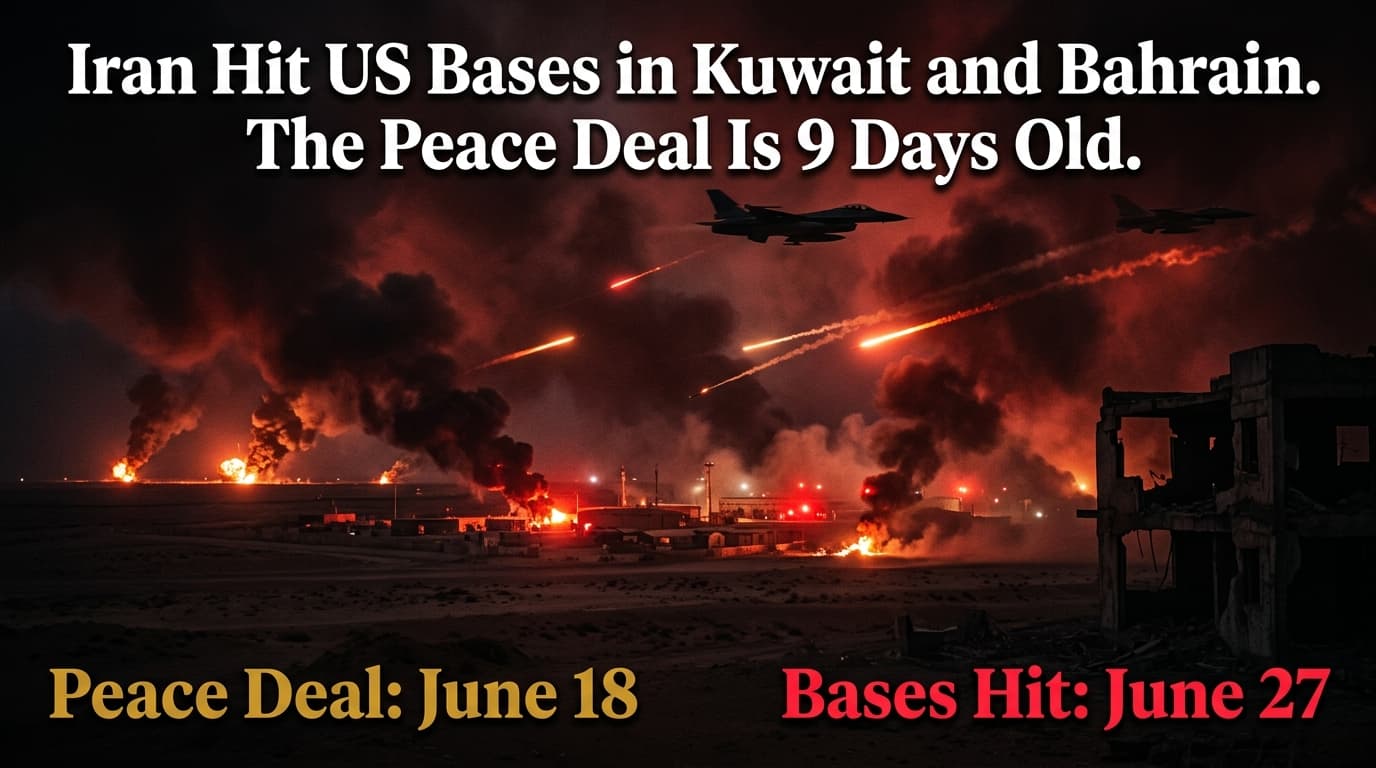
Iran's Islamic Revolutionary Guard Corps said it targeted US military facilities in Bahrain and Kuwait with missiles and drones on Sunday after the US military launched strikes on Iranian targets near the Strait of Hormuz, in what US Central Command described as a direct response to continued Iranian aggression. The exchange marks the most significant breakdown in the Versailles interim agreement since it was signed just nine days ago, and the first time the US has resumed offensive strikes on Iranian territory in roughly two weeks.
The United States resumed offensive strikes on Iranian territory for the first time in roughly two weeks when CENTCOM said six US aircraft struck four targets — Iranian missile, drone, and coastal radar sites along the Iranian coastline — on June 26, in response to a drone attack on a commercial vessel. US Navy and Air Force jets struck ten Iranian military targets in and near the Strait of Hormuz after what CENTCOM described as an Iranian attack on a commercial ship in the strait.
The trigger for the latest escalation was a shipping incident two days earlier. President Trump said Iran fired at least four one-way attack drones at ships transiting the Strait of Hormuz on June 25, with one striking the Singapore-flagged cargo ship Ever Lovely on its upper deck and damaging it, though the ship's main engine and navigation equipment continued to operate and no crew injuries were reported. Trump described the move as a foolish violation of the initial agreement to end the war.
Iran's response to the US strikes came within hours. After the US strikes, Iran's Islamic Revolutionary Guard Corps said it targeted US facilities in Bahrain and Kuwait with missiles and drones, with Iran's Foreign Ministry stating that the Islamic Republic reaffirms its determination to defend its national sovereignty and territorial integrity against US military aggression. A US official told Reuters there were no American casualties or damage after Iran targeted the facilities in Kuwait and Bahrain. Qatar's Ministry of Defence separately reported no casualties at Al Udeid Air Base, which hosts the largest US air base in the Middle East, following the IRGC's claimed strikes.
The Strait of Hormuz has become the central flashpoint of the deal's collapse. On June 20, Iran declared it closed the Strait of Hormuz again, citing Israeli strikes in Lebanon as a violation of its deal with the US — a claim the US military denied. Earlier on Saturday, Bahrain reported Iranian drone attacks on its territory, which hosts a US military base, and a tanker in the Strait of Hormuz was struck by an unidentified projectile, according to the United Kingdom Maritime Trade Operations, which said the vessel sustained damage but all crew members were uninjured.
The human cost of the broader conflict is now being tracked with increasing precision. Confirmed US military killed in action stands at 13 by Pentagon figures, with no new Pentagon-confirmed military deaths reported through the June 27 data cutoff, though some independent tallies cite 15. The Pentagon wounded count stands at 365 or more as of early May 2026, with independent estimates in the 520 to 543 range, and reporting has continued to flag a discrepancy between the official tally and the larger number of known casualties.
The diplomatic track that was meant to prevent exactly this kind of exchange is now in serious jeopardy. Key indicators being watched include whether either side signals a return to the de-escalation the memorandum was meant to lock in, whether US-Iran technical talks in Switzerland are formally suspended or resume, and whether Iran enforces its renewed closure declaration with further attacks on shipping or whether transits resume. The Switzerland talks, originally scheduled to lock in the terms left undefined by the Versailles agreement, have not been formally cancelled but have produced no confirmed rescheduling date.
On June 19, US President Donald Trump announced a renewed ceasefire between Israel and Hezbollah in the Lebanon conflict, facilitated by the US, Qatar, and Iran — a moment that briefly suggested the broader framework was holding. That signal lasted less than 48 hours. Israel continued to strike southern Lebanon numerous times after the announcement, and on June 20, Iran declared the Strait of Hormuz closed again, citing the Lebanese strikes as a violation of its deal with the US. The Lebanon front and the Hormuz front have now become mutually reinforcing pressure points, with each flare-up providing justification for the other side to escalate.
Trump has threatened more military action if Tehran continues to launch strikes, and a US official previously played down the prospect of escalation following recent strikes in the region, telling reporters the exchanges do not reflect a return to major combat operations — at least for now. Whether that distinction holds through the next 48 hours depends almost entirely on whether Iran's IRGC stands down its Hormuz posture or treats Sunday's exchange as the opening of a new escalatory cycle.
MorrowReport analysts will continue tracking CENTCOM statements, Hormuz shipping data, and the status of the Switzerland technical talks as the situation develops.