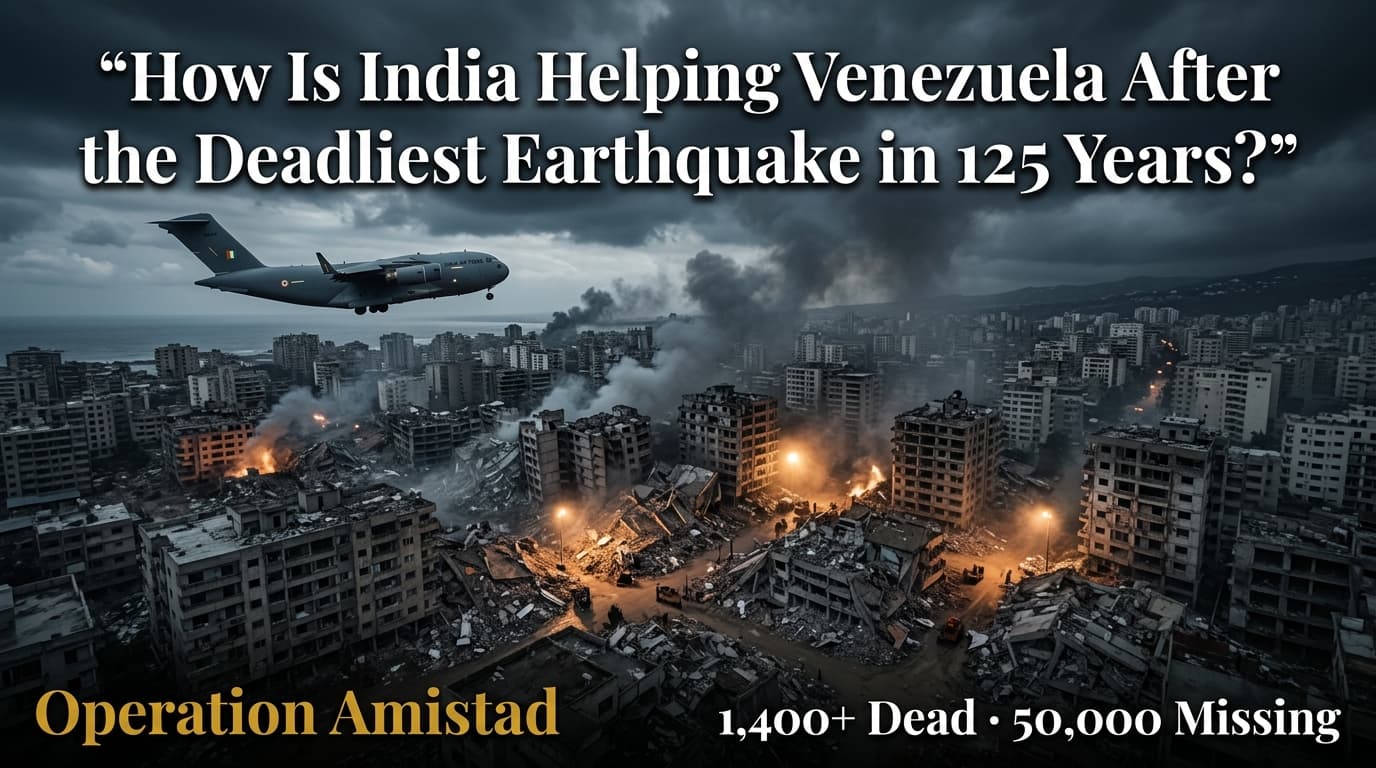
India launched Operation Amistad on Friday, June 26, dispatching two Indian Air Force C-17 aircraft to Venezuela carrying an Indian Army Field Hospital Unit, over 35 tonnes of relief supplies, medicines, and medical equipment, including two BHISHM Cubes. The operation makes India one of the first non-American nations to deploy a fully operational field hospital to the disaster zone following the strongest earthquakes to strike Venezuela in more than a century.
Two large strike-slip earthquakes struck northwestern and central Venezuela on June 24, with epicenters in San Felipe, Yaracuy. The first measured magnitude 7.2 and occurred at 6:04 p.m. local time, classified as a foreshock. It was followed 39 seconds later by a magnitude 7.5 mainshock — the largest in Venezuela since the 1900 San Narciso earthquake. (Naked Capitalism) The twin events sent shockwaves felt as far as 1,700 kilometres away and collapsed buildings across Caracas and the coastal state of La Guaira within the span of less than a minute.
At least 1,430 people were killed and more than 3,200 injured as of Saturday, according to officials, with the death toll continuing to rise as rescue workers reached areas that remained inaccessible in the first 48 hours. At least 172 people remain trapped under the rubble of collapsed structures, and more than 50,000 people were reported missing, a figure the Venezuelan government has not independently confirmed. The tremors affected at least 383 buildings, 13 hospitals, and 25 shopping centres across the country, with at least two hospitals — one in Caracas and one in La Guaira — collapsing entirely.
The Indian contingent comprises 41 personnel, including nine medical officers, and is equipped to provide emergency medical care, trauma management, life-saving surgical support, and other essential healthcare services to those affected. The deployment's most significant hardware is the two BHISHM Cubes — Bharat Health Initiative for Sahyog Hita and Maitri portable hospital systems developed by India's Defence Research and Development Organisation. Each BHISHM Cube can be deployed within minutes of arrival, providing surgical theatre, intensive care, and emergency medicine capabilities without requiring existing infrastructure, a critical advantage in La Guaira, where two hospitals are no longer functional.
External Affairs Minister S. Jaishankar announced the operation on social media, writing that the assistance contains an Indian Army Field Hospital Unit and over 35 tonnes of relief supplies, medicines and medical equipment. The operation follows Prime Minister Narendra Modi's offer of assistance a day earlier, in which he expressed being deeply saddened by the devastation and said India stands ready to extend all possible assistance. The name Amistad — Spanish for friendship — signals the diplomatic framing India has placed on the deployment, positioning it as solidarity rather than emergency response alone.
India's deployment fits a pattern of expanding humanitarian outreach that New Delhi has pursued consistently since 2021. Operation Dost delivered aid to earthquake-hit Turkey and Syria in 2023. Operation Karuna responded to Cyclone Mocha in Myanmar the same year. Operation Amistad extends that pattern to South America for the first time, a geography where India has limited traditional military presence but growing diplomatic and economic interests, including Venezuelan oil.
The broader international response has mobilised rapidly, with at least 30 search and rescue teams from various countries on the ground in Venezuela by Friday, according to the United Nations. The United States committed $150 million in aid and deployed Miami-Dade search and rescue teams — the first time in over a decade the State Department activated those units beyond its standard USA-1 and USA-2 deployment. US teams also repaired one of the runways at Simón Bolívar International Airport to allow heavier relief aircraft to land. France deployed 85 rescue workers specialising in search and clearance operations, while the Netherlands announced a two-million-euro aid package and China dispatched both a rescue team and emergency humanitarian supplies.
Venezuela's healthcare system entered the crisis already severely weakened, with hospitals facing shortages of water, antibiotics, IV solution, anaesthetics, and basic supplies before the earthquakes struck. Medical professionals described having to respond to the disaster with a collapsed healthcare system, relying entirely on willingness to help in the absence of adequate supplies. The Indian Army field hospital is therefore not supplementing a functioning system but filling gaps where the system itself no longer exists.
A magnitude 4.9 aftershock was detected off the northern coast of Venezuela on Friday, with tremors felt in Maracay and Caracas, adding to the psychological toll on a population already sheltering outdoors or in temporary camps. The USGS Prompt Assessment of Global Earthquakes for Response system predicted the final death toll could potentially exceed 100,000, a figure that would make the June 24 earthquakes among the deadliest natural disasters in South American history.
Acting President Delcy Rodríguez said electric services had been restored to roughly 60% of pre-earthquake levels, and that more than 14,000 officials were working in La Guaira alone, with access to the area remaining restricted as military and rescue personnel searched the wreckage. Whether the international deployment — including India's field hospital — arrives in time to change the survival rate for those still trapped will depend on how quickly Venezuelan authorities can clear the access routes that currently limit movement between Caracas and the coast.
MorrowReport analysts will continue tracking Operation Amistad's deployment progress and the evolving death toll in Venezuela as rescue operations continue.