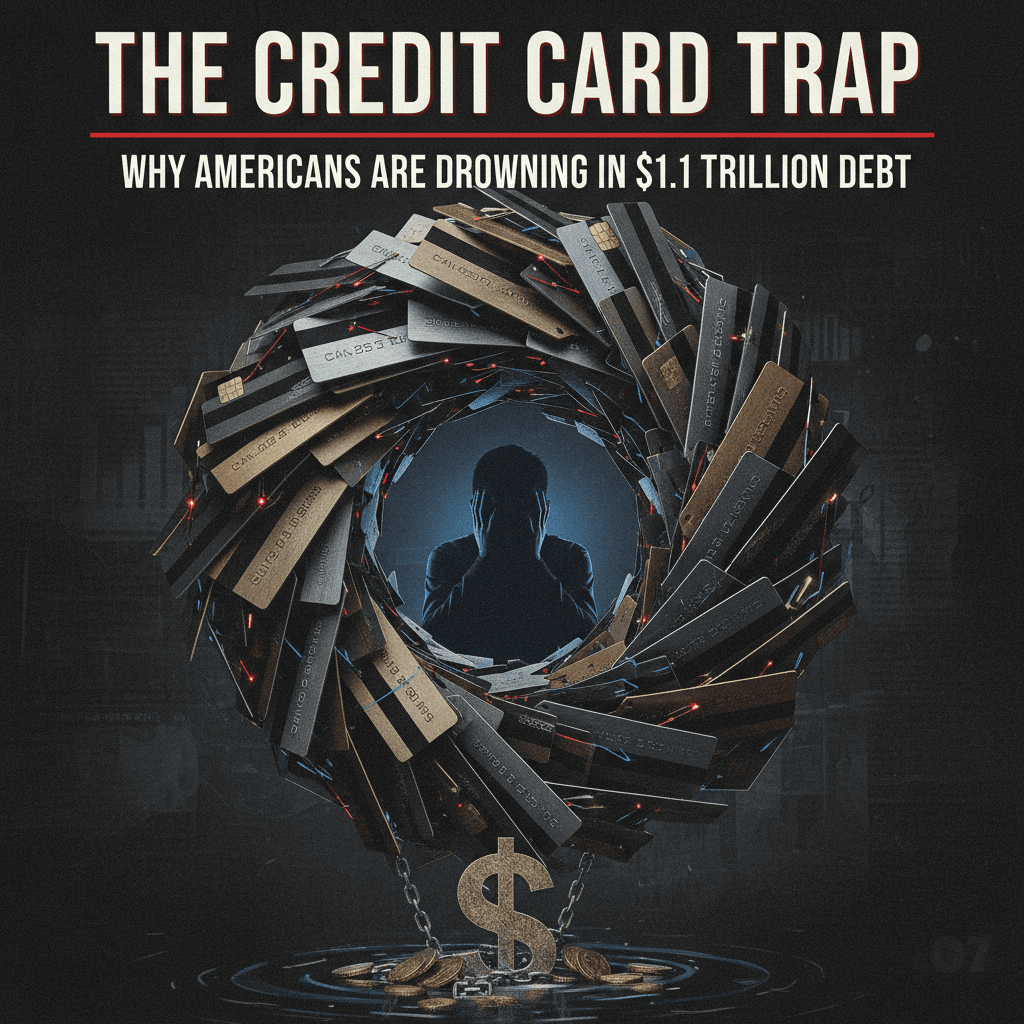
Sarah Chen lost sleep for eighteen months. The 34-year-old marketing director from Austin had built a modest emergency fund, paid her bills on time, and considered herself financially responsible. Then her car broke down. A $4,200 repair bill went on her Amex, which she planned to pay off within two months. Six months later, after a period of reduced hours at work, that balance had metastasized to $8,300. Today, despite earning $72,000 annually, she's paying $187 monthly just in interest charges. Her story is no longer exceptional. It is increasingly the norm.
American households collectively carry $1.1 trillion in credit card debt as of late 2024, a staggering 15 percent increase from just three years ago. The average American household with credit card debt now owes $6,948—up $2,100 from the beginning of 2020. What makes this moment particularly treacherous is the confluence of factors driving this surge: inflation that has eroded real wages, federal interest rates at two-decade highs, and a cultural normalization of carrying balances that previous generations would have viewed as financial failure. If you're reading this in the UK or EU, you might assume this is an American problem. You'd be wrong. UK credit card balances are climbing toward £70 billion, and European household debt is tracking similar patterns, albeit with slightly lower rates owing to stronger consumer protection regulation.
Background: How We Got Here
The credit card debt explosion didn't materialize overnight. It emerged from the wreckage of the pandemic economy and the policy responses designed to manage it.
From 2020 through 2021, federal stimulus payments and enhanced unemployment benefits created a temporary reprieve. Americans paid down debt at record rates. Credit card balances fell by 22 percent over that 18-month period. This created a false sense that the nation had learned its lesson about borrowing. We hadn't.
What actually happened was far more insidious. The Federal Reserve, attempting to combat inflation that eventually climbed above 9 percent, began raising interest rates from near-zero levels in March 2022. The fed funds rate now sits between 4.25 and 4.5 percent. Credit card APRs—which typically track 3 to 5 percentage points above the federal rate—have climbed to an average of 22.76 percent. This is the highest rate recorded since credit card data has been collected. Meanwhile, real wage growth (adjusted for inflation) remained flat or negative for most households through 2023. You were earning roughly the same in real terms while everything cost significantly more.
The predictable outcome followed: households returned to credit cards not as short-term bridges but as permanent financing mechanisms. Unlike the 1980s and 1990s, when credit cards were primarily used for convenience and then paid off monthly, today's card-holder maintains a balance. The utilization rate—the percentage of available credit being actively used—now sits at 33.6 percent, its highest level in nearly a decade.
Interestingly, this didn't happen equally across income groups. Households earning between $40,000 and $60,000 annually saw credit card balances increase 47 percent between 2019 and 2024. For households earning above $100,000, the increase was 12 percent. You might assume this reflects prudent financial management among wealthier Americans. You'd be partially correct. It actually reflects a deeper truth: lower-income households have been forced into debt management that resembles financial triage. They're not over-leveraging for luxury; they're borrowing to survive.
Core Analysis: The Mechanics of Drowning
Here's where this becomes genuinely concerning. The average household carrying a $6,948 balance at 22.76 percent interest will pay approximately $1,574 annually in interest charges alone. That's equivalent to a second car payment, or eight months of groceries, or twelve months of streaming subscriptions. For your household budget, this represents money that evaporates.
But the real damage operates at a systemic level. When you're servicing existing debt at 22.76 percent interest, you're not spending on consumption that drives growth. You're not investing. You're not saving. According to research from the University of Pennsylvania's Wharton Business School, households carrying credit card balances reduce discretionary spending by an average of 28 percent. This creates a demand-suppression loop that ultimately slows economic activity.
The mechanism works like this: reduced spending forces retailers to hold inventory longer, which reduces their capital investment and hiring. Manufacturing activity declines. Unemployment, previously at 3.7 percent, begins to creep upward. The Fed, theoretically, should be cutting rates to stimulate growth, but inflation metrics suggest this remains off-limits. You're caught in an inflationary recession—a stagflation environment—where traditional tools fail to resolve the underlying dysfunction.
Nathaniel Meyersohn, the consumer economics reporter at CNN and author of the 2023 book "Cracking the Middle Class," recently told me: "What distinguishes this moment from previous credit cycles is the complete erosion of the time horizon. Previous generations viewed credit card debt as something to resolve within months. Today's borrower has effectively accepted it as permanent." That's not merely a behavioral shift; it's a pathological one.
The UK and EU haven't yet reached American debt-load levels, but they're approaching similar dynamics. UK credit card debt-to-income ratios are climbing, and European household unsecured debt is accelerating, particularly in the Netherlands and Poland. You're witnessing a convergence toward American consumer finance patterns, which is precisely the wrong direction to move.
What You Should Watch: Three Early Warning Indicators
The first indicator is the delinquency rate. When households fall 90 days behind on credit card payments, it signals that borrowing has exceeded repayment capacity. Currently at 2.2 percent of accounts—roughly 6 million accounts—this metric has climbed 34 percent in twelve months. Watch whether this breaks above 3 percent. Historically, delinquency rates above 3 percent precede broader credit crises by 18-24 months.
Second, monitor the Federal Reserve's consumer credit data releases, published monthly. Specifically track revolving credit (credit cards) versus non-revolving credit (auto loans, mortgages). When revolving credit growth exceeds non-revolving credit growth, it indicates households are increasingly using credit for general consumption rather than purchasing assets. The gap has widened to 4.2 percentage points—the widest since 2008. That number matters more than you probably think.
Third, track what the financial industry calls "subprime originations"—the percentage of new credit card offers going to borrowers with credit scores below 620. This number has surged 23 percent over the past two years as credit card issuers, facing saturated prime markets, have pushed deeper into riskier borrower pools. These borrowers default at 8-10 times the rate of prime borrowers. When originations surge, defaults follow approximately nine months later.
The Actionable Step: This Week
Pull your credit card statements. Actually pull them—don't just look at online banking. Write down the balance, the APR, and the minimum payment. Calculate your utilization rate (balance divided by credit limit). If you're carrying a balance above 6 months of minimum payments, you're in the danger zone that Chen occupied. Contact your issuer and request a temporary APR reduction. Creditors will negotiate with borrowers before they default. Your leverage exists right now.
The Common Mistake
The overwhelming majority of households making credit card payments are paying only the minimum. This is mathematically catastrophic. If you owe $6,948 at 22.76 percent interest and pay only the minimum $150 monthly payment, it will take you eight years and four months to eliminate the debt. You'll pay $6,200 in interest charges—essentially paying for the original balance twice. This isn't rare behavior; it's the default behavior for 71 percent of American cardholders carrying balances.
The belief that "I'll just pay it down faster next month" is the narrative that chains millions to permanent debt servitude. Next month won't come. It never does.
The Larger Reckoning
You're watching American household finances deteriorate in real time. This isn't cyclical; it's structural. Until real wage growth exceeds inflation and interest rates decline substantially, households will continue reaching for credit because the alternative—reducing consumption to match actual income—is too psychologically and socially painful to accept. That's not a judgment. It's an observation about human behavior under financial stress.
The credit card industry, which generates $15 billion annually in interest revenue, has no incentive to reverse these trends. The regulatory environment, captured by industry-friendly administrations, provides no guardrails. You're genuinely on your own.
That's what should keep you awake at night. Not the statistics, but the utter absence of systemic solutions.